
Book Review and Author Interview: Rural: The Lives of the Working Class Countryside by Rebecca Smith
Rural: The Lives of the Working Class Countryside by Rebecca Smith (HarperCollins, 2023)

The publisher’s blurb describes this as “a book for anyone who loves and longs for the countryside, whose family owes something to a bygone trade, or who is interested in the future of rural Britain.” Many of us love the countryside but with 82.9% of England’s population, 83% of Scotland and around 80% of Wales (2019) living in urban areas, Britons may seem more detached than ever from rural life. Those of us with UK ancestors are likely to have at least some forebears living in the countryside in the first half of the 19th century, if not later. And with debates about fuel and food dominating recent headlines, awareness of our rural economies, communities and environment urgently needs to improve.
I was particularly keen to read this book as I grew up in rural Lancashire in the 1980s and ’90s. It was a world that even then felt remote and misunderstood. On my first day of secondary school, for example, I was astonished at how many of my new classmates had never heard of the village where I lived. Sadly, I was equally ignorant of city ways, constantly getting lost trying to find the bus station after school for my long and winding journey home. As the daughter of the forester on the Graythwaite Estate in Cumbria, Rebecca Smith was raised in an even more remote area around 40 miles from me.
Smith’s family had long ties to the land: her ancestry includes foresters in Cumbria, miners in Derbyshire, millworkers in Nottinghamshire, and builders of reservoirs and the Manchester Ship Canal. In Rural, she explores the realities of life in the country, weaving back and forth between her childhood, life now in rural Scotland, her ancestors’ experiences, and those of other lives on estates and farms across the UK.
I’m often frustrated by contemporary media accounts which simplify or glamorise rural life, focusing on Downton Abbey-style worlds, wild swimming, or cooking on the AGA. In fairness, there have been some improvements on television recently, but Smith’s book provides a healthy counterbalance to the twee, shining a light on professions and communities that many know nothing about. She has a healthy curiosity for the variety of rural lives and a rich range of sources – as evinced by the detailed reference section at the end of the book.
I was pleased to read of a world I recognised, both the past of my ancestors and the precarious world of my farming friends who are forever multi-tasking and coming up with creative ways to turn a profit in a challenging economy. Whether you are interested in diving deeper into the everyday lives of your ancestors or are keen to understand more about the rural economy and the importance of caring for the countryside in all our lives, this book is warmly recommended.
Interview with Rebecca Smith
I worked in radio for over a decade. After graduating with an English and Media degree from Stirling University, I wanted to write but had no idea how to do it. I had really enjoyed the radio aspect of my degree so managed to get some work experience in local BBC Radio and basically never left. I worked on live programmes, news phone-ins, comedy, features, drama. I was always really keen to tell other people’s stories. To give people a voice who didn’t usually have one. I found different lives fascinating.
Latterly, I worked in Radio 4’s Scotland’s office and really loved working with books and scripts again. At that point, I decided it was time to start writing myself. After I had my second kid, I decided to go freelance and take a Masters in Creative Writing at Glasgow Uni. Then I came up with the book!
Why did you want to write Rural?
I read a lot and love so many genres but I never really came across anything which I thought, yes, that’s me. There were a lot of working-class stories coming out when I started writing but nothing about rural areas. So I started writing about that. Also, I think quite subconsciously, I always wrote about the place I grew up as if it had some kind of tether to me. We lived on a country estate in Cumbria, which immediately makes people think we were posh, but we were anything but. We were given a tied house, which meant the house came with the job. If you lost one, you lost the other. There was a whole community of people living like this who ran the Big House and the land; the farmer, the plumber, the housekeeper, the gamekeeper, and the forester (my dad.) I wanted to tell this story, about belonging to a place when you don’t own any of it. It was only when I started talking to my family I realised that they had all lived in tied houses in rural areas their whole lives, generations of them. No wonder I felt tethered to this kind of place; it was in my blood.
Why did you feel that exploring the lives of the working-class countryside was important? Originally I was only going to write about country estates and those microcosms of societies. But the more I thought about it, and ultimately spoke to family, the more I realised so many more rural industries had tied housing. Coal mining, slate mining, millwork. My grandad was born in a dam builders hut just above Sheffield. My Great Grandmother had thirteen children and had numerous lodgers come and go to help with the money coming in. I had no idea about this until I spoke to my Uncle Jim. I was very lucky he is a keen family researcher. He sent me lots of information which was just fascinating. I wish I had spoken to my Grandad about it all before he died. Not only was he born on the moors as a dam builder’s son, he went on to be a coal miner during the war, and then worked in a mill.
There is a lot of literature about these industries but I wanted to write about all of them in the same place, because I found the people who work in them are all connected in so many ways. But I also wanted to write about them from a woman’s point of view. I was pregnant while writing some of the book which has the ability to totally change your perspective! When I thought about my Great-Grandmother with her thirteen children, plus lodgers, in a tiny hut miles away from anywhere, it makes you wonder how they did it.
What’s next for you and your writing? I have an idea for the next one but it’ll take me quite some time to formulate anything worthwhile just yet! The lead up to this first book (plus my there children) will keep me busy enough for now I think.
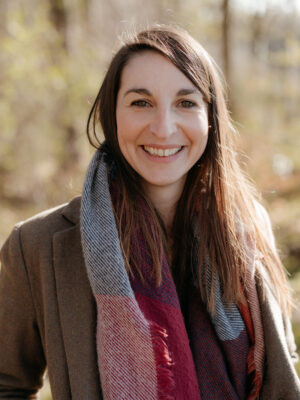 Rebecca Smith is a writer from Cumbria. She worked in radio for ten years before completing a Masters in Creative Writing at Glasgow University. She lives in Central Scotland with her partner and three children. Rural: The Lives of the Working-Class Countryside is her first book.
|


