Blog

In the course of studying for an MA in Imperialism and Culture, I have been examining how enthusiastic working class Britons were about the Empire in the period 1870-1914.

Emma Jolly, in the article Naming for Empire

Emma Jolly writer, historian, genealogist
  1. Book Review and Author Interview: Angel Meadow by Dean Kirby
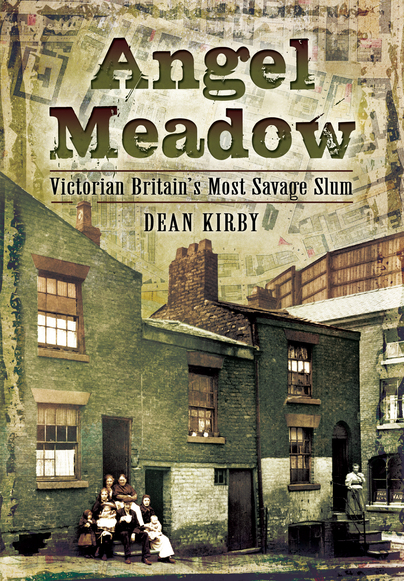
    Angel Meadow

    Angel Meadow: Victorian Britain’s Most Savage Slum by Dean Kirby (P&S History, 2016)

    Dean Kirby’s immersive exploration of Manchester’s Angel Meadow slum in the Victorian era is a compelling journey into one of the most notorious and dangerous neighbourhoods of the Industrial Revolution. In his meticulously researched book, Kirby, drawing on his journalistic background, vividly resurrects the scenes and characters that define this grim chapter in history.

    The book is thoughtfully structured around real events, offering readers a glimpse into the shocking and colourful stories that unfolded in Angel Meadow. Kirby’s dedication to historical accuracy is evident, as he taps into a diverse range of sources, including newspaper accounts, police reports, teachers, missionaries, and magistrates. This thorough approach results in a comprehensive historical record that becomes an essential resource for anyone interested in the lives of those who inhabited this bleak corner of the northern metropolis.

    What sets Kirby’s work apart is not only its historical depth but also its connection. This project is a labour of love for the author, inspired by the experiences of his ancestor, William Kirby, a farm labourer who fled Ireland’s Great Hunger only to face the grim reality of the industrial north.

    The narrative is enriched with a glossary of Angel Meadow slang, providing a linguistic window into the past, and supplemented by a bibliography, research notes, and a detailed index. These elements contribute to the book’s value as both an engaging read and a scholarly reference.

    In summary, Dean Kirby’s book on Angel Meadow is a masterful blend of historical documentation and personal passion. It not only brings to life a vivid and dangerous Victorian slum but also honours the author’s familial connection to the tumultuous events that unfolded in this dark corner of Manchester’s past.

    Interview with Dean Kirby

    What was your background before writing this book?  

    I was born and grew up in Manchester and am very proud of the city and fascinated by its history. Manchester was the first industrial city and played a significant role in the creation of the modern world. My dad has always told me stories about Ancoats, the inner city district where he lived as a young lad, and we would spend hours in Manchester Central Library in the 1980s researching our family history – before genealogy was fashionable – using the old, dimly-lit microfilm readers that genealogists used before records were digitised and which were probably really bad for your eyes. After university, I became a journalist and I’ve spent most of my career working in Manchester – going out into communities and talking to ordinary Mancunians about what was happening in their lives – which has given me an even greater appreciation for my home city and its people. The book happened really because these two things – my family history and my passion for the city and its history – came together quite dramatically in 2016.  

    Your ancestor William Kirby lived in Angel Meadow. Was it solely the discovery of his residence there that inspired you to write about Victorian Britain’s most challenging slum, or were there other motivating factors?

    I had been researching my Irish ancestor William Kirby, my 3 x great-grandfather, on and off since those early days in the library with my dad. William was a farm labourer from County Mayo who arrived in Manchester in the 1860s. Like a lot of poor Irish immigrants at that time, he lived with his family underground in a cellar. Using maps, rate books and other records, I eventually managed to locate the site of his house in a car park in Angel Meadow, where I used to park my car because it was convenient for the Arndale Centre. In Manchester, when slum clearances took place after the Second World War, the houses were simply backfilled into cellar holes and sealed over with concrete. As the city centre is largely flat, a lot of that land was turned into surface car parks which are only just now being redeveloped. 
    One night in 2016, I was walking past the car park where Williams’ house had been with my wife as we went to a Noel Gallagher gig at Manchester Arena and noticed that, amazingly, there was a fence up and a big sign saying “archaeologists at work”. The next day I went back and told them my story. They invited me inside to look at their finds and later let me bring along my dad to climb down a ladder into the cellar holes and touch the bricks of William’s fireplace. They let me take the brick home and I’ve kept it. It still has soot on it from the fire that would have kept him warm on a winter’s day. A death certificate showed that one of William’s children, also called William, died in that house from a fever aged just two weeks old. It says something about the horrible living conditions there, but it also affected the archaeologists, they said, because that’s how long their dig lasted – the same number of days as baby William’s short life. 

    Visiting the house was a hugely poignant moment for me. As family historians, we all spend our time searching for pieces of paper that will give us a glimpse of how our ancestors lived, but in that moment, we were able to walk right through the front door. That moment inspired me to write the book about the district where William lived and to go on to do a doctorate in urban history – researching the Victorian housing conditions in the same area of Manchester. It means I’ve been researching that small area of the city for a decade now. I’m still very grateful to the archaeologists who didn’t turn me away when I turned up with what must have seemed a surprising story. Instead, they invited me in and encouraged me, and I’m hoping that my PhD study of Angel Meadow’s housing will give something back to them and help them in their own research going forward.   
     

    Did you have concerns about portraying some of the distressing stories you encountered during your research?

    I did have concerns about portraying some of the distressing stories in the book and there were some that I left out because they were just too unbearable to write about. It was also quite harrowing at times being immersed in those stories during what was four years of research and writing. One story that played on my mind quite a bit was about a woman named Annie Chapman, who was found dead in a privy in Angel Meadow. It’s only a few paragraphs in the book, but her story was so tragic that I thought about her quite a lot while I was writing. One valid criticism of the book was that I didn’t write about the families who lived good, honest lives and never found themselves in trouble with the police or the pages of a newspaper. I totally agree and there’s also an obvious gap in telling the stories of women who lived in working-class districts in the nineteenth century because their stories are often missing from the historical record, or written by men such as police officers and church missionaries who knew nothing really about women’s lives. All I could do, as I was writing about an era which no one is alive to remember, was to use as many different sources as I could find and try my best to portray people’s lives as accurately and fairly as I could. I also felt it was important to treat the people whose stories I was telling with respect and be a voice for them if I was able, as, like my own family who lived in the district, these were real people and the ancestors of modern-day Mancunians. In a way, the book was my attempt to keep alive the stories of those people and to explain what they went through while living in very difficult circumstances.

    Who was the most memorable individual you encountered in your research for the book?

    There were a few memorable people I encountered in my research and some had interesting nicknames such as Cabbage Ann, the Badger, One-Armed Kitty and Jemmie the Crawler. One thing I enjoyed doing was using genealogy techniques to try to work out the real identities of the people behind the nicknames and find out a bit more about their lives. The Badger, for example, was a thief named John Currie and it was said that he could climb down coal chutes to break into houses. By looking at his prison record though, I also found that his distinguishing marks included his neck being bloated and badly scarred by scrofula, an infection of the lymph nodes caused by tuberculosis. It’s a horrible nickname to have given to someone with a medical condition, but in the days before mugshots and fingerprinting the name would have been a way for police officers to identify him in the street. Cabbage Ann’s real name was Ann Powell and she ran a grocer’s shop and a lodging house. She was a notorious thief trainer who taught youths how to be “breech buzzers” or pickpockets. The most memorable person in my research though was a violent character named Henry Burgess, who would go around Angel Meadow attacking passers-by and the police with anything he could lay his hands on. He had 40 convictions to his name including killing an opponent by throwing a paraffin lamp at him and setting him on fire. I was very lucky to find a photograph of Henry in the Staffordshire Gaol image archive, which is a useful resource for historians searching for Victorian criminals who were transported from the North of England to jails in the South such as Dartmoor, Pentonville and Parkhurst. They would stop at Stafford Gaol on the way and have their photograph taken. It was fascinating to see Henry’s piercing eyes peering back at me in the photograph and to notice that on his neck he had a huge scar, which may have been a knife wound that would have put his life in danger before he was stitched up by a surgeon. 

    One of my greatest joys in writing the book is that I have been contacted by lots of people who have found their ancestors in the index and have been in touch to find out more information. I was really lucky to chat with one of Henry Burgess’s descendants recently who wanted help with their genealogy research and I was able to pass on some documents and the photograph. They had been unaware of his past until reading about him in the book and it was a real privilege to chat to them after spending so much time thinking and writing about Henry during my own research. 

    What’s next? Can we expect more books?

    Since writing the book, I have been taking an even deeper dive into Angel Meadow by researching my PhD, which I finished last year. I really enjoyed it but I’m keen now to write another Manchester history book. I am currently doing some research. Beyond that, I’ve started a newsletter telling stories from the streets of Victorian Manchester, which is free to join. I’m also in the process of setting up a genealogy business so I can help more people find their Mancunian ancestors and tell their stories.    

    Dean Kirby is an award-winning investigative journalist whose nominations include being shortlisted for the Orwell Prize for Exposing Britain’s Social Evils for his work on the UK’s fuel poverty crisis. His book on Angel Meadow has been in the Amazon best-seller lists. He now writes a weekly newsletter telling stories from the streets of Victorian Manchester, which can be found at www.manchesterhistory.uk.

  2. Book Review and Interview: Who Killed Constable Cock? by Angela Buckley

    Who Killed Constable Cock? by Angela Buckley

    This book is short but surprising. Angela tells this true crime story with a steady pace, which left me unprepared for the astonishing twists and turns. The case initially seemed straightforward but by close examination of the late 19th century Manchester underworld alongside an increasingly-advanced police force transformed the book into a page-turner. By the end, I could not put it down. The tension is heightened particularly by the fact that the story is true and I had begun to invest emotionally in the real people who became the characters in this book.

    How did you encounter the Constable Cock case?

    When I first became interested in crime history through researching my family tree, I began reading about true crime cases in my home city of Manchester. I was shocked to learn that a police officer had been killed just near my childhood home a century before I grew up there.

    At first, I thought the story was going to be straightforward. I was pretty startled when the book took a dramatic turn with Charlie Peace’s confession. Peace was an extraordinary character. What were your thoughts on him?

    Initially, I thought that Charlie Peace was a burglar who turned to violence to get him out of a tight spot, but my opinion of him changed completely when I read his confession at the National Archives. I now think that he was a man who was constantly on the lookout for trouble – he deliberately targeted his former lover and her husband and, although he claimed that he shot Arthur Dyson in self-defence, he showed no remorse and placed the blame firmly on the victim. It was the same for Constable Cock – Peace explained how it was the officer’s fault for not stepping away. His confession revealed a man who was defiant, unapologetic and possibly paranoid.

    You grew up in Manchester, where this book is set. Your popular police biography, The Real Sherlock Holmes: The Hidden Story of Jerome Caminada (Pen and Sword, 2014) is also set in the city. What draws you to explore the historic underworld of your hometown?

    It’s funny because I had no real idea of Manchester’s history when I was growing up there, probably because we didn’t learn about it at school. It wasn’t until I researched my family’s roots in the city that I really began to see what it would have been like living there in the 19th century.  Through my own family history, I was drawn into the city’s dark Victorian underworld and it has hooked me ever since. It was such a multilayered and fascinating place in Victorian times and there is always so much more to discover. I moved away from Manchester years ago, but my work has given me a real sense of my own personal history and background.

    One aspect of the story that stood out for me – and something that appeared to complicate the progress of the case – was the prevailing social attitude toward Irish immigrants. Today we would describe this as racism. Is this something that you have encountered elsewhere in your historical research, either for your own family or for your writing? 

    I was obviously aware of racial tensions and prejudice in Manchester when I was growing up there in the 1970s and 80s, but I didn’t realise that hostile attitudes towards immigrants had been prevalent for so long. My own family was from Italy and I was quite shocked to discover the prejudice they faced when they arrived in Manchester in the 1880s and especially how the Italian community was treated during the Second World War, when many of the older generation, including members of my family, were interned. My research into the history of the Irish community for Who Killed Constable Cock? was particularly distressing. As a Catholic, I went to school with many Irish families and I had no idea that they had suffered so much deprivation and abuse.

    You have researched extensively in police records and museums. What has stood out for you in the history of policing and methods of detection?

    I’m particularly interested in the police detectives and how they developed their sleuthing skills. As there was no formal training in the 19th century, they learnt on the job and had to keep their wits about them as they faced the challenges of fighting crime in some of the most notorious rookeries in Victorian England. I am fascinated by their pioneering work and I love reading about their adventures.

    What are you currently working on?

    I’ve started researching another real-life Victorian murder for a possible book project and this time I’m investigating the work of the early Scotland Yard detectives. I’d also like to take my study of Victorian police detectives further and I’m hoping to research ‘the art of sleuthing’ for a PhD.

    Angela Buckley is a true crime writer and author. Her work has featured in many national newspapers and magazines.  Who Killed Constable Cock?  is available in ebook and paperback. You can find out more about Angela’s work on her website, www.angelabuckleywriter.com and on her Facebook page Victorian Supersleuth.


  3. Book Review and Author Interview: The Malice of Angels by Wendy Percival

    The Malice of Angels by Wendy Percival (SilverWood Books, 2017)

    The reality of life as a genealogist can be quite mundane. I spend most hours in front of a computer, with the odd day out to archives or networking events. In the world of genealogy fiction, however, our imaginary counterparts have eventful lives, regularly being held at gunpoint, taking helicopter flights, or being lured into tunnels by sociopathic clients. Fortunately, my clients are invariably pleasant individuals but the part of me that wanted to be a detective when I grew up wouldn’t mind sharing some of the fictional adventures occasionally.

    I previously blogged about popular genealogical mystery writer, Steve Robinson, and his hero, Jefferson Tayte. Recently, I decided to try the work of Devon-based author, Wendy Percival, and discover the world of her researcher protagonist, Esme Quentin. Wendy has written three books so far, but I chose to begin with the third. The Malice of Angels is a novel based upon the experiences of women in the Second World War – a topic of personal interest to me. I very much enjoyed the book and look forward to reading more by Wendy. I most enjoyed the little-known aspects of the 1940s that Wendy brought into the plot. I also appreciated the intelligent focus on women’s history, as this is still, sadly, an area that is too often overlooked.

    In order to find out more, I interviewed Wendy about the book and her inspirations.

    This is your third Esme Quentin mystery. How long have you been a professional writer?

    I suppose the point at which I became a “professional writer” when the first Esme Quentin mystery, Blood-Tied was published by Robert Hale in 2008. I’d been writing for a few years by then, learning my craft, so to speak. I wasn’t sure then whether there would be more Esme stories but it was clear from the reaction I got from readers that Esme was a popular protagonist so it seemed a good idea to write another. By the time I’d written the second, The Indelible Stain, the world of publishing had changed hugely. The rights of Blood-Tied had reverted to me by then, so I decided to re-publish it as an ebook and paperback, following it with The Indelible Stain the following year and then in October 2017 with The Malice of Angels. In between, I wrote Death of a Cuckoo for SilverWood Books, for their sBooks “short reads” imprint.

    Before becoming a writer, I was a primary school teacher for 20 years. I moved to Devon in 1980 to take up my first teaching post in a small rural school, back in the days when primary education was much more holistic, integrated and inspirational. I left the profession when I could see the way things were heading!

    Much of the plot of Malice touches on the work of female agents of the Special Operations Executive (SOE). I researched some of these agents for my Society of Genealogists’ guide, My Ancestor was a Woman at War. I never fail to be amazed by their bravery, ingenuity and varied skill sets. What drew you to feature SOE in this novel?

    It really started with a local news report about an elderly lady who’d died in Torquay in 2010. To her neighbours, she was someone who, although polite and not unfriendly, kept herself to herself and they knew little about her. But it emerged after her death, that she’d been an SOE, and her name was Eileen Nearne. Something must have triggered a memory of the story a few years later, I really can’t remember what — it was probably WW2 anniversaries and personal recollections reported on the news — which prompted me to read Eileen’s biography, followed by Bernard O’Connor’s book Churchill’s Angels, which systematically logs the experiences, some of them terrifying, of all the women SOEs. What I read inspired several plot points in Malice! I then came across a fascinating book called A Life in Secrets by Sarah Helm about Vera Atkins, who’d made it her personal mission after the war to find out the fate of every SOE she’d waved off to occupied France. It’s a brilliant book. If you’ve not read it, I can thoroughly recommend it.

    Photograph of the coast where The Malice of Angels is set.

    You live in north Devon, where most of this book is set. What appeals to you about this area, both as your home and as a setting for your fictional characters.

    I moved to Devon from the Midlands 38 years ago to take up a teaching post and I’ve never wanted to live anywhere else! For many years I lived and worked close to the North Devon coast so I know it well. I love the wildness of the area I use as the settings for my later books (Blood-Tied was set in Shropshire, where my ancestral “journey” began). I now live right in the middle of Devon, in unspoilt countryside, overlooking a lovely river valley, in a very pretty village with a 13th century Grade One listed church and a cluster of traditional thatched cottages (one of which is ours!). Even the parish hall is thatched! (As you can probably tell, I’m a glutton for old buildings.) It’s a bit further to travel to the north Devon coast these days, but from an author’s perspective, I’ve found it useful to stand back from the place I write about. I think you see it through fresh eyes when you’re not living there all the time. We often take our camper van and stay at the campsite when we need a sea “fix”. The views are magic and the rugged coast is amazing.

    What’s next for you and Esme?

    I promised myself that once Malice was published, I’d give some time to my own family tree and sort out what has become a bit of a chaotic jumble of records and photographs over the years. I also have a few stories about my immediate family I want to write — about my dad who as a child spent 3 years in hospital and was told he’d never walk again but did, about my maternal grandmother who became a professional opera singer at the age of 16 and toured the country’s theatres, about my mum’s recollections of growing up in WW2, including having a bomb drop on to her bed and about the mystery (as yet not completely unravelled) of why my great-aunt walked out of the family home, aged 16 in 1904 and “was never heard of again” until, in her 90s, she was reunited with her only surviving sibling, my paternal grandmother. Not to mention the urge to record my own memories…

    But on the back-burner of the fiction section of my writer’s brain, there is already something brewing for Esme to get her teeth into, so I’m sure it won’t be long before I’ll start plotting again!

     The time-honoured ‘box of old documents in the attic’ stirred Wendy’s interest in genealogy – the inspiration behind her Esme Quentin mystery novels. When not plotting fiction, she’s either digging up her own family history secrets or enjoying the coast and countryside of Devon, which has been her home for the past 38 years.
     

  4. Review of Amelia Dyer and the Baby Farm Murders by Angela Buckley

    ameliadyer

    Angela Buckley is well-known among family historians as the Chair of the Society of Genealogists and for her work on true crime. Her first book, The Real Sherlock Holmes: The Hidden Story of Jerome Caminada (Pen & Sword, 2014) explored crime and criminals through the life of a 19th century Italian-Mancunian detective.

    This latest title is the first in Buckley’s historical true crime series, Victorian Supersleuth Investigates. Focusing on the crime (or in this case, crimes), Buckley carefully pieces together the facts using contemporary reports supported by her research into socio-historical sources.

    Buckley was inspired to explore the crimes of Amelia Dyer when she discovered she lived close to the Reading location where the baby farmer’s victims were found in the River Thames. The true number of Dyer’s victims will never be known, but the book names all those identified through Dyer’s trial, the police investigation, and the rather sensational newspaper reporting of the time. As such, this is a valuable resource for family and social historians. There are details, too, of those who found the victims, along with other witnesses and neighbours.

    One of the mysteries of this case for a modern reader is why did anyone hand over their infants to the murderous Dyer? Buckley provides the background to this, explaining the myriad difficulties in the late Victorian period for women who were unmarried or unable to care for their own children. In my view, the socio-historical detail is one of the book’s greatest strengths.

    Another strength is the lucid writing. Not only is the book easy to read, but the complexities of these crimes and the motivations of the rather puzzling Dyer are explained clearly. Although the subject matter is harrowing, criminal details are balanced against fascinating passages of social history. Despite being full of dates, names and times. the book is short and well-paced. As such it is suitable for anyone wanting to read a book on holiday or during a daily commute. It certainly transports the reader to another world.

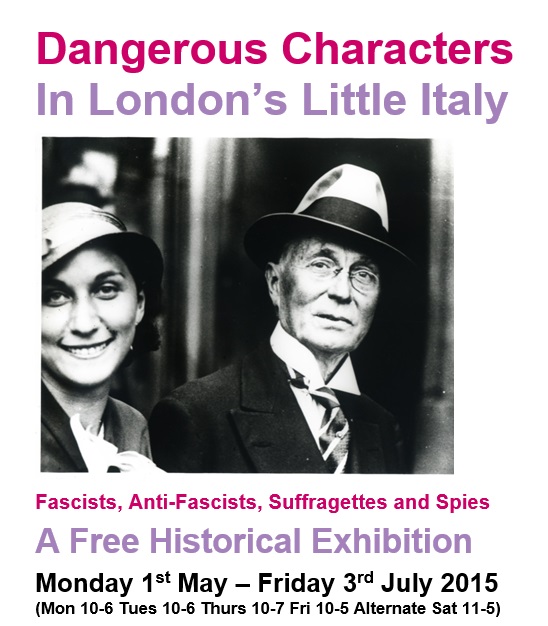
  5. Dangerous Characters In London’s Little Italy Fascists, Anti-Fascists, Suffragettes and Spies

    IMG_1683Last week I went to see the latest exhibition at Camden Local Studies and Archives Centre in Holborn and was amazed to learn about a little-known tragedy of the Second World War. The exhibition, “Dangerous Characters in Little Italy” is curated by Alfio Bernabei. Among its exhibits is a section on the sinking of the Arandora Star on 2 July 1940. 805 souls were lost, of which 470 were Italian. It struck me that this is an event that we should commemorate in the way of the Lusitania or other wartime maritime losses. Astonishingly, the exhibition reveals that at the time the event was hidden and little attention was paid to it in the decades that followed.

    Built in 1927, the Arandora Star was originally a leisure cruiser belonging to the Blue Star Line. Recommissioned for war service in 1939, the ship served as a carrier for troops and civilian evacuees. In June 1940, she sailed from Liverpool, transport 734 Italians and 479 Germans who had been interned in Britain to Newfoundland in Canada. Also on board were 86 German prisoners of war and 174 officers and crew. Accompanying them were their guards: 200 Allied naval and military personnel. There was no supporting vessel, indicating that the ship was carrying civilians, and no Red Cross had been painted on the ship.

    Around 100 miles west of Bloody Foreland, Donegal, the Arandora Star was torpedoed by a German U-boat. As the internees clambered into lifeboats, some were shot by their guards to prevent them from escaping. A Canadian destroyer rushed to the scene, managing to rescue 868 lives. In all, 713 internees and 92 guards and crew lost their lives. They included the Captain, E. W. Moulton, 12 officers, 42 crew, 37 military guards, 470 Italians and 243 Germans.

    IMG_1682

    This incident and the silence that followed it, reflected the fear of Italian fascism in Britain during the war. “Dangerous Characters in Little Italy”, first exhibited by Centro Studi P. Calamandrei,Palazzo della Signoria, Jesi, Italy, highlights how fascism grew in Britain’s underground, and how many Italians sought to challenge it. The audio-visual display is based on Bernabei’s research about Italians in Clerkenwell and Soho in the period 1920-1940 and features the rise of Fascism and within the Italian community in London, as well as the activity of the Italian and non-Italian anti-Fascists to oppose it. The exhibition covers the period between the rise of Fascism in Italy in the early 1920s and Italy’s declaration of war on the side of Nazi Germany.

    “Dangerous Characters in Little Italy: Fascists, Anti-Fascists, Suffragettes
    and Spies” is a free exhibition at Camden Local Studies and Archive Centre, 32-38 Theobalds Road, London WC1X 8PA and runs until Friday 3rd July 2015 (Opening Hours: Mon 10-6 Tues 10-6 Thurs 10-7 Fri 10-5 Alternate Saturdays 11-5).

Latest From Emma's Blog

A History of the Census Takers: Recording the Nations by Mish J Holman (Pen & Sword, 2026)

Looking beyond the census returns to explore the lives and personalities of the people who created them A History of […]

[Read more]

Book Review and Author Interview: A History of Parish Registers in England and Wales: From the Restoration to Civil Registration by John Wintrip (The Lutterworth Press, 2026)

A History of Parish Registers in England and Wales: From the Restoration to Civil Registration by John Wintrip (The Lutterworth Press, […]

[Read more]

Member of The Society of Authors Member of The Association of Genealogists and Researchers in Archives Graduate of the Institute of Heraldic and Genealogical Studies Canterbury Member of the Society of Genealogists Pharos Tutors