A History of the Census Takers: Recording the Nations by Mish J Holman (Pen & Sword, 2026)
Looking beyond the census returns to explore the lives and personalities of the people who created them
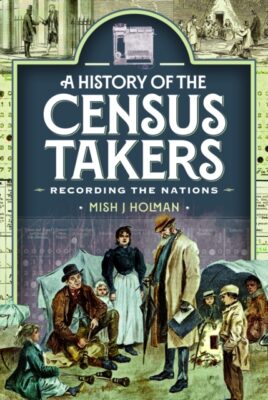
A History of the Census Takers: Recording the Nations by Mish J Holman (Pen & Sword, 2026)
A History of the Census Takers explores a fascinating aspect of census history that has received surprisingly little attention: the enumerators themselves. We are familiar with the census as one of the most useful sources for family historians, and there are plenty of books examining these records. This book, however, gives us a behind-the-scenes glimpse, exploring how those records were created and the individual lives and personalities of the people responsible for them.
I particularly enjoyed the way Holman breaks up the text with contemporary quotations, newspaper reports and examples of social history. It makes the book easy to read and adds colour and context, making the book accessible to all – not just committed genealogists. The detailed research into individual enumerators is especially interesting.
This is a remarkably thorough piece of work and a valuable addition to the literature on the records we use in family history. It offers a different perspective on a familiar source and will give family historians (and others) a greater appreciation of the people behind the census returns we spend so much time searching.
Interview with Mish J Holman
What was your background before writing this book?
I originally wanted to be a make-up artist for film and TV, but I didn’t make the grade when I was interviewed at art college. By this time (A-levels), I had already begun working on my family tree and had taken a part-time job as a Saturday assistant at the local library. Without anything better on the horizon I was able to get a full-time job for the same library after A-levels and stayed a number of years trying to decide if I wanted a career in libraries. I gained a lot of preparatory experience for my current profession; after all, there was always a book about genealogy on the return trolley or a question asked about the discipline while I was on duty as a reference librarian. I later took on a role as music cataloguer, a position that required meticulous attention to detail and provided another set of skills that I could transition to my current occupation.
It was while working in the library stacks, a behind the scenes world of wonder the public rarely sees, that I stumbled across an enormous volume of material belonging to the Merchant Taylors’ Company. By this time I recognised the genealogical value of such material, and for an instant I imagined myself swanning around libraries and record offices as a profession. This vision, together with chronic illness, made me decide to cut my library employment to part-time, so I could spend time on developing myself as a professional genealogist. When I look back on it, I was quite poor in those days. We think we know a lot, but in fact we know very little. I’m glad I took steps to educate myself and I later completed the University of Strathclyde’s post-graduate certificate.
This year is the thirtieth anniversary of my genealogy business, Family History Gifts. I eventually gave up library work to concentrate on it and being a professional genealogist. It’s not been easy, it’s now a very competitive market. One needs to know what genealogists need in the digital age – it’s very different from thirty years ago. One-to-one coaching has helped in that respect; clients used to hitting the Hints link now require methodology help, and other clients don’t want dull reports; they want stories. In my opinion, the way genealogists are taught to write reports is very poor.
Your book explores an area of family history that hasn’t received much attention. What inspired you to move beyond the more familiar or popular themes and focus on this subject?
After having researched hundreds of families and chased them across censuses, I started to ponder the details of the process. What really intrigued me was what did the householder think when the enumerator knocked on their door to explain the purpose of the census? How did they perceive government officials? Was it as a threat? Or as someone trying to help them? Were they indifferent? When they realised they had to give up information about themselves, how did they feel about the intrusion? Intrusion came up quite a bit in discussions at parliamentary level for Potter’s Bill etc., and later with census refusals. So it must have been a big deal. We know that 18th century ideas of personal liberty bled into the 19th century, and by the end of the century notions of health visitors were met with resentment and accusations of a nannying state. With the census, it seemed that people could only be assuaged with the assurance of confidentiality. With that in mind and with such a penetrating focus on their backgrounds and private life, the question was were their answers determined by how much they wanted to give away about themselves. How truthful were they or were they just confused by the whole process? The book reveals that domestic servants and labourers were often reluctant to give information that might threaten their employment.
Of course the book is also about the enumerators themselves and what they endured for the sake of their duty. I thought it was time to see them as human beings and not grey faceless officials, who across the decades have often been accused of incompetence and ignorance. I wanted to know who they were and what were their motives for taking on the role. Did they bring with them their own biases (of course they did) and what did they think of the job when it was all over? In the end, I came to the conclusion the public saw them as both a threat and someone who was trying to help them. Some householders were glad the government took notice of them.
During your research, did you come across a particularly memorable story or discovery—something that surprised or even shocked you?
Yes many. The highlights of which were householders not knowing the official names of their nearest and dearest. Husbands not knowing wives’ names and vice versa arose a number of times in the reports. There was the odd case of parents not remembering their children’s names – which I suppose suggests nicknames were widely used – and having to refer to the family bible for help. But how widespread this was, we can only guess.
Elsewhere, and I believe this was more common, there were families who sent a child or children to another family member because they thought the schedule was too small. Now for those of us who have seen the size of the original schedules, there seems to be plenty of room even for large families. The householder could also ask for an extra schedule too if the family unit was massive. So it wasn’t until I read reports of how householders filled in the schedule that the penny dropped that something else was happening. Enumerators reported they were given schedules either filled in with massive handwriting written across all columns paying no attention to the column/row format, or in tiny writing filling the entire page giving the life stories of all the household. It seems many householders thought they should provide as much information as possible, often for fear of not providing the required information. Therefore my theory is they appraised the schedule as being too small for their family information and sent their child off to auntie or granddad. It’s such a shame that enumerators had to filter out so much useful information for genealogists, but that wasn’t the purpose of the census.
What are your future plans? Can we expect more books from you?
It got to a point while writing the book that the word count grew to 120,000 and it was way above the limit, so it was agreed with the publisher that I should chop Ireland. Sorry Ireland. The good news is I have a quarter of a book written about the Ireland censuses and its processes. Judging by what I’ve written and researched so far it will be a different book; this is mainly due to the fact that the Irish enumerators left few accounts, so my sources will be different.
I also have a contract for a book of dates for genealogists. I so wanted a handy guide to the most important dates for practical research when I started my research in the 1980s and it’s been on my mind since. I started the project many years ago in a spreadsheet, so it’s there, burgeoning in my consciousness. I need it because I still can’t remember the date of the 1881 Census.
The other ideas I have are a theatrical biography and a book about genealogical methodology. There are a number of very good books on the subject, but none seem to cover the aspects and angles of advanced problem solving. I’ve had to develop so many strategies over the years, they’re worth sharing.