Blog

From 1822, when the Dickens family settled in Camden, to 1860 when the author took permanent residence at his Kent home of Gad’s Hill Place, London was his home.

Emma Jolly, in the article Dickens and London

Emma Jolly writer, historian, genealogist
  1. Book Review and Author Interview: Ancestoring: Understanding Records, Family, and Ourselves by Darcie Hind Posz
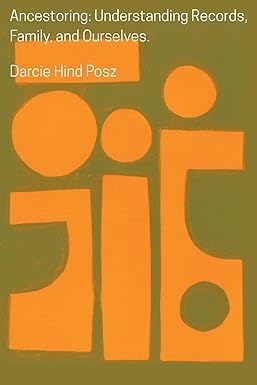
    Ancestoring: Understanding Records, Family, and Ourselves by Darcie Hind Posz (Genealogical Publishing Company, 2026)

    In 1926, Carl Jung concluded a lecture to a literary society in Augsburg with the claim that the archetypes buried in our collective unconscious carry ‘the deposit of man’s whole ancestral experience,’ which genealogist Hank Jones later interpreted in Psychic Roots as meaning that ‘we inherit the wisdom of the experience of our ancestors without ourselves having personal experience.’ This is one of many thought-provoking influences and references that appear in this exciting new book from accomplished US genealogist and writer Darcie Hind Posz. Its eighteen chapters are alive with ideas and inspiration. I found it fascinating and have found myself returning repeatedly, pondering how I can apply the thoughts and examples to my own family history. Completely different from many of the genealogy books out there, Ancestoring brings influences from the current memoir or ancestral self-discovery vein, which has prevailed in publishing in recent years. 

    In her preface, Hind Posz defines Ancestoring as, ‘The observation and collection of methodologies, theories, and solutions to everyday items as related to genealogy.’ The entire book involves fresh ideas and inspires the reader to look anew at their own family tree and the assumptions they’ve made about their ancestors. From its title to the use of examples (the section on source analysis, in particular, is revelatory) and quotations from a wide range of genealogical papers, this is something original and illuminating. 

    The book’s dedication quotes from William B Saxbe, Jr., who refers to ‘thoughtful genealogists’. That appears to be the target audience here. If you consider yourself a ‘thoughtful genealogist’, then, without doubt, this is the book for you.

    Interview with Darcie Hind Posz, CG®, FASG

    What was your background before writing this book? 

    I have been working in libraries and as a genealogist for twenty years. I have been a verifying genealogist for several lineage societies. I have worked as an editor for a publication. I have volunteered. When I was not doing that, I was finding time to write, which I enjoy. 

    I hadn’t heard the term “Ancestoring” before this. How did you come up with the title of the book? 

    At first, I wanted a field guide or something like a field guide for all of these methods that I had used over the years that worked for me. I liked ancestoring to describe it because it was not strict, but a bit whimsical and in that grey area. I had the idea in 2017 originally to use pictures to describe how I visualized solving genealogical problems I carried with me, and I had begun to collect notebooks full of doodles. During the pandemic, I came back to the notebooks because I was running out of projects. It kept getting bigger, so I made myself commit to finding a publisher open to a book that is hard to describe. 

    This is your fourth book. How does it differ from your previous titles? 

    This book is different because I feel like I got to keep my voice in it. When you write a genealogy, you are an observer of a family; your tone is kept in check with the documents formulating the narrative. When you write about a region, again, you are kept in check by the resources you are discussing. Both are pointing the reader to resources and then a family narrative to evaluate and observe. But getting to the part where you have a final family narrative to publish or distribute is not that simple. There are rabbit holes, diatribes, blind alleys, and other things (like losing an entire line in the pedigree), where they have no room in the final product. I wanted to show that and work in progress because what didn’t work for my genealogical problem may work for someone else’s. 

    In Part Two (Understanding Families), you write: “Rather than judging our subjects, which will likely flatline the part of our brain we use to understand them, observe and evaluate their actions.” This approach strongly resonates with my own work in personal family history research, as well as what I encourage in my clients. Do you think genealogists are shifting in how they approach their ancestors (e.g. those considered “black sheep”) compared to how family history was typically handled in the recent past? 

    I hope they are. It is hard. It would be nice to have deeper conversations about topics like this. It is easy to judge swiftly when an ancestor does something and to label it. But we need to think of those we study not as something like a document. As their lifetime progressed, they shifted and changed. Think about how you have done things during your life. Maybe you did something that seemed like a good idea at the time, and now you regret it. We all do it. Those we study in genealogy did the same. That is why I liked to frame it as withholding judgment, so that you do not know yet if they are the good or bad person in the story. Just watch longer. 

    In Part Three (Understanding Ourselves), you touch on genetic genealogy, writing that, “DNA will overturn many previously proven or established pedigrees.” What is the most powerful discovery you have made through DNA research? 

    I was sure of my lineage until DNA overturned it, and although DNA is this wonderful evidence available now, just like documentation, we will have to wait as more of it becomes available by waiting for more people to take DNA tests and providing a larger pool for those of certain ethnicities. I will spend the rest of my life combing through match lists to see if there is a hint of that line! Since it will be a lifelong process, I will need to keep up-to-date on the technology and methods for it. 

    What are your future plans? Can we expect more books from you?  

    More books, of course! 🙂
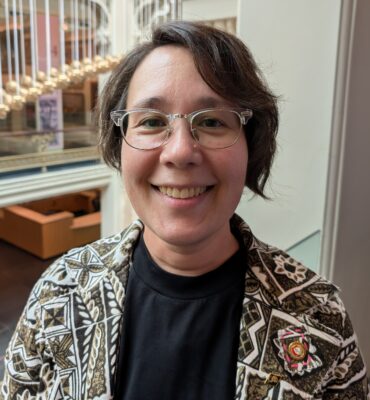
    Darcie Hind Posz, CG®, FASG, is an author, genealogist, and researcher, and has been a board-certified genealogist since 2013. In 2023, she was elected a Fellow of the American Society of Genealogists. Darcie Hind Posz is an author, genealogist and researcher. Posz authored three other books: Chicago Stones: A Genealogy of Acquisition, Influence & Scandal; Recast: Vital Events Published in Variety in 1918 and 1919; and Research in Hawaii, part of the National Genealogical Society’s Research in the State series, was published in 2024. Her extensive bibliography can be found at her website, darciehindposz.com


  2. Genetic Genealogy – Biogeographical Ancestry

    Biogeographical ancestry (BGA) is now the preferred and more accurate term for what DNA testing companies have traditionally called “ethnicity.” Another commonly used term is BioAncestry.

    Until recently, genetic genealogists—including myself—referred to these findings as “ethnicity results.” To align with current terminology, I am updating this blog with the preferred terms and sharing my latest results.

    The five most popular DNA testing sites for ancestry and health insights are AncestryDNA, 23andMe, MyHeritage DNA, FamilyTreeDNA, and Living DNA.

    Ancestry

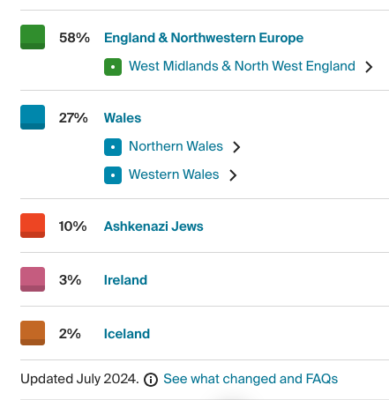
    Ancestry’s most recent BGA update was in July 2024, and my results align well with my documented family history.

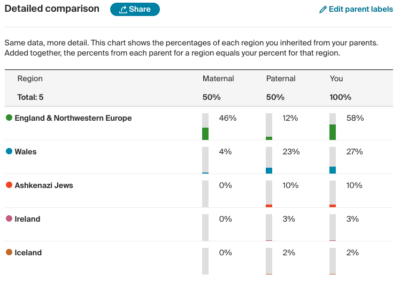
    I was especially pleased to see the West Midlands highlighted, as this is where most of my maternal ancestors lived in recent centuries. The Welsh ancestry reflects both my paternal and maternal heritage, while the 10% Ashkenazi Jewish matches what I would expect from my great-grandfather.

    The 3% Irish may be linked to either my Scottish or West Welsh ancestors, but the Icelandic component appears to be an anomaly—I suspect it will disappear in the next update.

    23andMe

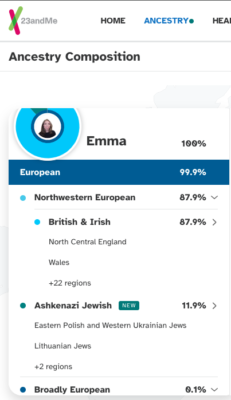
    Like Ancestry, 23andMe has accurately highlighted my West Midlands heritage. Even better, it identifies my mitochondrial haplogroup as T2b, which aligns with my known ancestry.

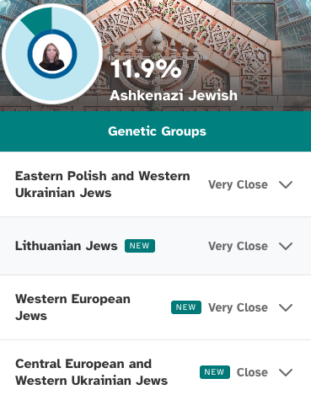
    23andMe categorizes my Ancestral Composition as European, further dividing it into Northwestern European and Ashkenazi Jewish, with percentages that match my documented family history.

    One advantage of 23andMe is its detailed regional breakdown beyond just the West Midlands. It identifies four distinct British regions in my ancestry:

    North Central England

    Defined as “north central England and parts of the West Midlands, including Staffordshire, Leicestershire, West Midlands, Cheshire, and Derbyshire.”

    • Common maternal haplogroups: H1, T2b, and H1c.

    • Since my maternal haplogroup is T2b, this fits well with my ancestry.

    Wales

    Defined as “Wales and England’s Welsh border counties,” which includes parts of the West Midlands.

    • Common maternal haplogroups: J1, H1, and T2b.

    • Again, T2b is listed, reinforcing my maternal connection to this region.

    West Midlands

    Defined as “Shropshire, Staffordshire, Worcestershire, Herefordshire, and Warwickshire,” though most people in this genetic group have ancestry near Birmingham.

    • Common maternal haplogroups: J1b1a, R0, and H1.

    • Interestingly, T2b is not listed here, even though my maternal line is from the West Midlands as far back as I have traced. However, since T2b appears in both the North Central England and Wales groups, it suggests my maternal ancestors may have been in this broader area for centuries. More research is needed!

    England & Southern Uplands of Scotland

    This category covers all of England and parts of upland Scotland.

    • Common maternal haplogroups: U5a1a1, H5a1, and H1b.

    On my paternal side, my Ashkenazi Jewish ancestry does not come from my Y-DNA line but from a different paternal branch. We know that my 2x great-grandfather, Abraham Israel, came from Poland, and our family has strong ancestral ties to Ukraine. These results fit well with what we know so far.

    MyHeritage

    MyHeritage has once again accurately identified my European origins, while also providing a more detailed breakdown of my Ashkenazi ancestry.

    MyHeritage claims to offer the most diverse and detailed Jewish ethnicity analysis available, with five Jewish ethnic groups and 55 Genetic Groups of Jewish origin.

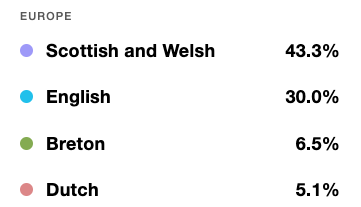
    European Breakdown

    My results show:

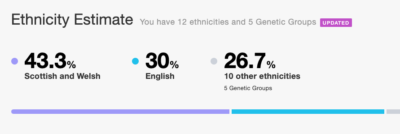
    • 43.3% Scottish & Welsh

    • 30.0% English

    This seems reasonable, especially if the Welsh category includes some of my West Midlands ancestry. However, I find it odd that Scottish and Welsh are grouped together.

    The biggest surprise in this update is the unexpected appearance of:

    • 6.5% Breton

    • 5.1% Dutch

    These results seem questionable, and I suspect they may disappear in future updates.

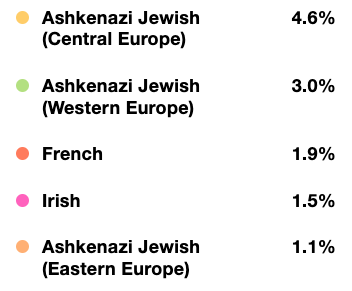
    Ashkenazi Jewish Breakdown

    Unlike other testing companies, MyHeritage provides a more nuanced interpretation of my Jewish ancestry, dividing it into:

    • 4.6% Ashkenazi Jewish (Central Europe)

    • 3.0% Ashkenazi Jewish (Western Europe)

    • 1.1% Ashkenazi Jewish (Eastern Europe)

    This level of detail helps clarify regional origins within my Ashkenazi lineage, which aligns with what I know about my family’s history.


    Family Tree DNA

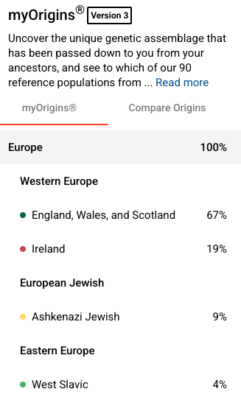
    My FamilyTreeDNA myOrigins® Version 3 Results

    Here’s a look at my latest myOrigins® Version 3 results from FamilyTreeDNA. As expected, my ancestry is 100% European, but the breakdown offers some different results from the other testing companies.

    Western European Ancestry

    • England, Wales, and Scotland – 67%

    • Ireland – 19%

    This aligns well with my known family history. The grouping of England, Wales, and Scotland together makes it harder to pinpoint specifics, but given my strong West Midlands roots, I assume much of this percentage is from that region. The 19% Irish is also intriguing—it could be linked to either my Scottish or West Welsh ancestors, though more research is needed to confirm.

    European Jewish Ancestry

    • Ashkenazi Jewish – 9%

    This fits closely with what I already know about my Ashkenazi Jewish heritage, which comes from my great-grandfather’s line. It’s interesting to see this as a single category here, whereas other testing companies sometimes divide Ashkenazi ancestry into more specific regions.

    Eastern European Ancestry

    • West Slavic – 4%

    This is an interesting addition. My Ashkenazi Jewish ancestors had strong Polish and Ukrainian ties, so it makes sense that a Slavic percentage appears in my results. It would be interesting to see if this changes in future updates.

    Overall, these results are a good match for my documented genealogy, though the broad regional groupings leave some room for interpretation. It will be interesting to compare this with future updates and results from other DNA testing companies!

    LivingDNA

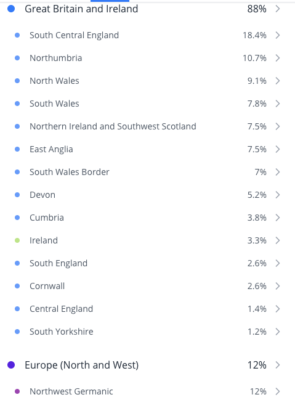
    My Living DNA results provide a detailed breakdown of my British and Irish heritage, with 88% of my ancestry linked to regions across Great Britain and Ireland. Unlike some other testing companies, Living DNA offers a more regionalized view, identifying specific areas where my ancestors may have lived.

    British Isles Breakdown

    The largest proportion of my ancestry is from South Central England (18.4%), which aligns with my known family history. There are also notable contributions from Northumbria (10.7%), North Wales (9.1%), and South Wales (7.8%), suggesting a mix of English and Welsh ancestry. The Northumbrian doesn’t fit with documented research nor the results from other companies, but the Welsh is more accurate.

    Other regions appearing in smaller percentages include:

    • Devon (5.2%) and Cornwall (2.6%), possibly indicating connections to the West Country.

    • Cumbria (3.8%), which may be linked to the English-Scottish border region.

    • South Yorkshire (1.2%), a relatively small proportion but still notable.

    No Jewish ancestry has been identified in this breakdown, despite its appearance in results from other companies. It is unclear where it is.

    Germanic Ancestry

    Unlike previous tests, Living DNA has identified a 12% Northwest Germanic component. Could this be connected to the missing Ashkenazi ancestry? Or could it reflect historical migration into Britain, possibly from Anglo-Saxon or Viking populations>

    Conclusions

    Overall, my updated BGA results offer a detailed view of my British ancestry, highlighting multiple regional connections and providing valuable insights into broader ancestral patterns. However, there is still room for improvement, and I look forward to future updates.


Latest From Emma's Blog

A History of the Census Takers: Recording the Nations by Mish J Holman (Pen & Sword, 2026)

Looking beyond the census returns to explore the lives and personalities of the people who created them A History of […]

[Read more]

Book Review and Author Interview: A History of Parish Registers in England and Wales: From the Restoration to Civil Registration by John Wintrip (The Lutterworth Press, 2026)

A History of Parish Registers in England and Wales: From the Restoration to Civil Registration by John Wintrip (The Lutterworth Press, […]

[Read more]

Member of The Society of Authors Member of The Association of Genealogists and Researchers in Archives Graduate of the Institute of Heraldic and Genealogical Studies Canterbury Member of the Society of Genealogists Pharos Tutors