
Book Review and Author Interview: A History of Parish Registers in England and Wales: From the Restoration to Civil Registration by John Wintrip (The Lutterworth Press, 2026)
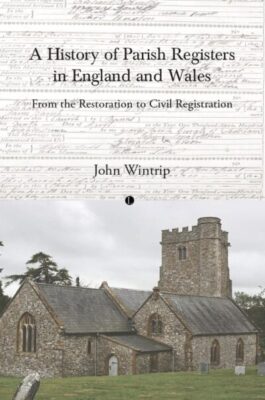
A History of Parish Registers in England and Wales: From the Restoration to Civil Registration by John Wintrip (The Lutterworth Press, 2026)
As expected from a genealogist of John Wintrip’s calibre and experience, A History of Parish Registers in England and Wales is a work of meticulous research and impressive detail. Even readers already familiar with the history of parish registers will find much that is new here. Who knew, for example, that one of the earliest diocesan initiatives to improve parish registers in the late eighteenth century emerged from the Diocese of Carlisle?
Wintrip makes potentially dense material highly accessible through a varied layout, generous use of examples, and an excellent range of primary sources. The book is also supported by a detailed index and glossary, making it a practical reference work as well as a scholarly study.
The chapters move systematically through the development of parish registers, beginning with their origins before 1660 and tracing their evolution through major legislative and diocesan reforms up to civil registration in 1837. I love the use of the regional case studies (Carlisle, York, Chester, St Asaph, Norwich, Salisbury, and Durham), which are enjoyable to read, while also showing just how varied local practice could be across England and Wales.
This is a valuable book for beginners, experienced family historians, and professional researchers alike. More than simply a guide to registers, it offers a wide-ranging view of the parish system itself and the socio-historical framework within which records were created and maintained. As Wintrip notes, the study is concerned solely with the parish registers of the Church of England. But, by retaining this tight focus, the work ultimately brings fresh depth to the record-keeping culture that underpins English family history research from the sixteenth century onwards.
Interview with John Wintrip
What was your background before writing this book?
After graduating in chemistry in 1973, my first career was as a science librarian, working mainly in universities. Having developed a keen interest in my own family history during the 1990s, the chance to take early retirement in 2007 provided an opportunity to pursue a new career as a professional genealogist. In anticipation of this possibility, I had already gained an IHGS Higher Certificate in 2006 and was subsequently awarded a Diploma in Genealogy in 2008. I was admitted as a Member of AGRA in 2009.
Having long been aware of the dearth of books providing guidance on researching before 1837, and after several years as a professional genealogist, I subsequently wrote two books covering this period. While writing these books, I became particularly interested in the origins of the detailed parish registers introduced in several dioceses and a few parishes elsewhere in the late eighteenth century, so decided to investigate this topic as a personal project after retiring from professional practice, presenting my findings in the form of an IHGS Licentiateship dissertation in 2019. I have continued to investigate features and idiosyncrasies of parish registers for which there is little or no explanation in the published literature, and have written several articles for the Genealogists’ Magazine.
Why did you choose parish registers as the subject of your latest book?
The most recent book to cover the history of parish registers in any detail was published in 1968 (General Sources of Births, Marriages and Deaths before 1837, by D.J. Steel; volume 1 of the National Index of Parish Registers). Several new discoveries in relation to the parish registers of the long eighteenth century have subsequently been made, initially by archivists, local historians and historical demographers, and more recently by me. I therefore began to think about bringing together what is now known about parish registers during this period into a coherent narrative, which could potentially be published in the form of a book. I was very fortunate that Lutterworth Press were sufficiently intrigued by my proposal to offer me a contract.
You have examined changes in official records in England and Wales during a period of considerable transformation. Which element did you find most noteworthy?
I think the most noteworthy element is the exceedingly slow pace of reform. Civil registration was introduced in France in 1792, for example. When it was finally introduced in England and Wales in 1837, the existing system of parochial registration had been widely acknowledged as not fit for purpose for the best part of a century.
Few people are aware that the system for recording births, marriages and deaths in England and Wales could have been completely transformed in the mid-eighteenth century if voting in Parliament had taken a different course. Bills proposing considerable improvements in the recording of births, marriages and deaths were introduced in 1753 and 1758, but both were rejected. It is interesting – although ultimately frustrating and futile – to consider how things might have developed had one of these Bills been enacted.
You highlight several significant individuals throughout the book. Was there one who stood out to you in particular?
Yes, Shute Barrington (1734-1826), who served as Bishop of Durham from 1791 until his death, and appears to be the only bishop to have taken a personal interest in the improvement of parochial registration. He was already engaging with this issue while serving as Bishop of Llandaff, communicated his concerns and proposals to clergy in the Diocese of Salisbury in 1789, and finally introduced his unique and innovative system for registering baptisms and burials in the Diocese of Durham in 1798, where it was followed in virtually every parish until standard printed registers were introduced in 1813.
Although Barrington’s initiative was relatively short-lived in comparison with similar initiatives in other dioceses, I consider his forms of entry to have been the most efficacious, as they achieved a fine balance between the ability of informants to provide the details being asked for and the usefulness for posterity of the information being recorded.
What are your future plans? Can we expect more books from you?
Having begun my research into the history of parish registers almost a decade ago, I have no plans to write any more books. Although I think there is a clear need for an up-to-date work on the history of non-Anglican registers, I have neither the inclination nor the motivation to embark on such a project at my stage in life. However, there are a few topics in relation to parish registers, which I have touched on in my book, that I would like to explore further, such as the apparent divergence in meaning between ‘baptism’ and ‘christening’ in some parish registers towards the end of the eighteenth century. I may write further articles for the Genealogists’ Magazine if I make any significant discoveries.

John Wintrip began investigating his family history in the 1990s. Following an earlier career as a science librarian and a decade of practising as a professional genealogist, he turned his attention to investigating features and idiosyncrasies of parish registers for which he had found no satisfactory explanation in the recent published literature, receiving a Licentiateship in Heraldry and Genealogy for his dissertation on this topic in 2019. He has been a Member of the Association of Genealogists and Researchers in Archives (AGRA) since 2009.


