Blog

For family historians, enjoyment comes not just from seeing our ancestors’ names in print or learning about the worlds they inhabited, but in reading the very words they read.

Emma Jolly, in the article Historic Newspapers

Emma Jolly writer, historian, genealogist
  1. Exhibition Review: Suffragettes and Other Feminists in Camden

    “A Stone’s Throw from Westminster: Suffragettes and Other Feminists in Camden” launched this evening at Camden Local Studies and Archives Centre in Holborn with performances, songs, and an introduction by comedian, writer and activist, Kate Smurthwaite.

    Inspired by Camden’s radical feminist past, Suffrage Arts has curated a diverse history of women’s political and social campaigns in the borough across the decades, with the back wall covered in posters from recent times.

    Displays feature a variety of activists who lived locally and made unique contributions to women’s rights. These include Mary Wollstonecraft (who wrote A Vindication of the Rights of Women while living in Store Street), Frances Buss (founder of Camden School for Girls), Millicent Fawcett (led the National Union of Women Suffrage Societies while living in Gower Street), Margaret Bondfield MPCicely Hale, Cicely Hamilton, Ernestine Mills, Olive Hockin, Alice Zimmern (lived in Lissenden Gardens), Charlotte Wilson, and Barbara Castle.

    Barbara Castle (1910-2002), who lived in Belsize Park Gardens.

    Map showing who lived where in the Camden area

    There is a section devoted to the centenary of women lawyers, and another to those associated with the theatre.

    Digital Drama has contributed a section on the Endell St Military Hospital (staffed entirely by women).

    Visit the exhibition for free at Camden Local Studies and Archives Centre, 2nd floor of Holborn Library, 32-38 Theobalds Road, London WC1X 8PA; Tel: 020 7974 3860, web: www.camden.gov.uk/localstudies

    Mon and Tue 10am-6pm, Wed closed, Thu 10am-7pm, Fri 10am-5pm by appointment only, Sat 11am-5pm alternate weeks (23 Jun, 7 Jul, 21 Jul, 4 Aug, 18 Aug, 1 Sept, 15 Sept).

  2. Explore the Past Guide

    Recently I was contacted by Rebecca Meekings, who works on behalf of Explore The Past (the Worcestershire Archive & Archaeology Service).

    Several members of my maternal grandmother’s family are from Worcestershire. My 3x great grandmother, Elizabeth Hannah Mould (1825-1904) was born in Smethwick, Staffordshire. She lived in the area of Smethwick all her life, but moved into the neighbouring area of Oldbury – which is in Staffordshire. Afte the early death of her first husband (my 3x great grandfather, Henry Harrison (1834-64), Elizabeth married George Hall Dearn (1845-1913), a man 20 years her junior, and settled in Warley, Worcestershire. Unlike nearby Oldbury, Warley remained an area of rural farmland until after the First World War. Elizabeth came from a line of dairy farmers and Warley seems to have been the perfect place in this part of Worcestershire for her to continue her family’s rural practices.

    The West Midlands generally can be a difficult area for family historians to research as boundaries often changed over the years. Researching family who lived within a ten mile radius can require visits to four or five different record offices. Anything that makes family history research clearer for those of us with ancestors in this part of the world, therefore, is something to be celebrated.

    Thus I was delighted to learn that Explore The Past has created a comprehensive 70-page guide designed to provide advice for people getting started with exploring their family history in the Worcestershire area. The team say, “It doesn’t matter where in the world they are researching, this guide covers general support for everyone, as the team at Explore The Past understand that it can be difficult knowing where to start.”

    As I often find West Midlands geography confusing, my favourite section of the guide is that of maps and plans. This gives tips on exploring places relating to my ancestor’s homes and their surroundings.

    The guide also helps researchers learn more about the types of resources most commonly used to research family history, as well as providing guidance on how to gain access to original documents, maps, photographs. Overall, it is intended to help family historians understand more about what kind of records & services will help them on their journey of discovery.

    Full details on the guide are online at the Explore the Past website: www.explorethepast.co.uk/discover-your-past/

  3. Book Review and Interview: Who Killed Constable Cock? by Angela Buckley

    Who Killed Constable Cock? by Angela Buckley

    This book is short but surprising. Angela tells this true crime story with a steady pace, which left me unprepared for the astonishing twists and turns. The case initially seemed straightforward but by close examination of the late 19th century Manchester underworld alongside an increasingly-advanced police force transformed the book into a page-turner. By the end, I could not put it down. The tension is heightened particularly by the fact that the story is true and I had begun to invest emotionally in the real people who became the characters in this book.

    How did you encounter the Constable Cock case?

    When I first became interested in crime history through researching my family tree, I began reading about true crime cases in my home city of Manchester. I was shocked to learn that a police officer had been killed just near my childhood home a century before I grew up there.

    At first, I thought the story was going to be straightforward. I was pretty startled when the book took a dramatic turn with Charlie Peace’s confession. Peace was an extraordinary character. What were your thoughts on him?

    Initially, I thought that Charlie Peace was a burglar who turned to violence to get him out of a tight spot, but my opinion of him changed completely when I read his confession at the National Archives. I now think that he was a man who was constantly on the lookout for trouble – he deliberately targeted his former lover and her husband and, although he claimed that he shot Arthur Dyson in self-defence, he showed no remorse and placed the blame firmly on the victim. It was the same for Constable Cock – Peace explained how it was the officer’s fault for not stepping away. His confession revealed a man who was defiant, unapologetic and possibly paranoid.

    You grew up in Manchester, where this book is set. Your popular police biography, The Real Sherlock Holmes: The Hidden Story of Jerome Caminada (Pen and Sword, 2014) is also set in the city. What draws you to explore the historic underworld of your hometown?

    It’s funny because I had no real idea of Manchester’s history when I was growing up there, probably because we didn’t learn about it at school. It wasn’t until I researched my family’s roots in the city that I really began to see what it would have been like living there in the 19th century.  Through my own family history, I was drawn into the city’s dark Victorian underworld and it has hooked me ever since. It was such a multilayered and fascinating place in Victorian times and there is always so much more to discover. I moved away from Manchester years ago, but my work has given me a real sense of my own personal history and background.

    One aspect of the story that stood out for me – and something that appeared to complicate the progress of the case – was the prevailing social attitude toward Irish immigrants. Today we would describe this as racism. Is this something that you have encountered elsewhere in your historical research, either for your own family or for your writing? 

    I was obviously aware of racial tensions and prejudice in Manchester when I was growing up there in the 1970s and 80s, but I didn’t realise that hostile attitudes towards immigrants had been prevalent for so long. My own family was from Italy and I was quite shocked to discover the prejudice they faced when they arrived in Manchester in the 1880s and especially how the Italian community was treated during the Second World War, when many of the older generation, including members of my family, were interned. My research into the history of the Irish community for Who Killed Constable Cock? was particularly distressing. As a Catholic, I went to school with many Irish families and I had no idea that they had suffered so much deprivation and abuse.

    You have researched extensively in police records and museums. What has stood out for you in the history of policing and methods of detection?

    I’m particularly interested in the police detectives and how they developed their sleuthing skills. As there was no formal training in the 19th century, they learnt on the job and had to keep their wits about them as they faced the challenges of fighting crime in some of the most notorious rookeries in Victorian England. I am fascinated by their pioneering work and I love reading about their adventures.

    What are you currently working on?

    I’ve started researching another real-life Victorian murder for a possible book project and this time I’m investigating the work of the early Scotland Yard detectives. I’d also like to take my study of Victorian police detectives further and I’m hoping to research ‘the art of sleuthing’ for a PhD.

    Angela Buckley is a true crime writer and author. Her work has featured in many national newspapers and magazines.  Who Killed Constable Cock?  is available in ebook and paperback. You can find out more about Angela’s work on her website, www.angelabuckleywriter.com and on her Facebook page Victorian Supersleuth.


  4. Book Review and Interview: The Chicago Stones by Darcie Hind Posz

    The Chicago Stones: A Genealogy of Acquisition, Influence & Scandal by Darcie Hind Posz (Darcie M. Posz, 2017) 
    Price: $14.99 (U.S. Dollars)

    Darcie Hind Posz wrote The Chicago Stones as part of her studies as a professional genealogist. This extensive and engaging romp through one hundred years of Stone and Yager family history originates in 1835 with one man who bought land, which would go on to fund three generations. Family historians – and others keen to explore further – will appreciate the transcriptions of original records, pre- and post-1871 Chicago fire records and discussions, a Register style of the Yager genealogy, and recommended listening (my favourite part). As an Englishwoman, I savoured the tales of upper-class US society and the history of the rapid growth of American cities, alongside the later depiction of the early transatlantic social scene. Prince Harry and Megan Markle are perhaps the most recent couple to follow this long line of transatlantic couples from the upper echelons of society.

    In order to find out more about this family and family history research across the pond, I interviewed Darcie about the book and her inspirations.

    What first drew you to the Stone family?

    They lived in an interesting time in American history and they had so much, but a majority of the recorded moments in their lives were of great unhappiness: deaths, divorces, escapist travels. It was so dissimilar to my ancestry; I just had to discover more about these people.

    It was an opportunity to broach subjects that have been mentioned too briefly in genealogical publications.

    I used the deaths of minors to explore dimensions of the major characters. A biographer once mentioned to me that she really felt like the deaths of children (who do not live past infancy) really do impact a subject’s timeline, let alone their psyche, but people tend to leave out those events because the children did not live past a certain age. If it impacts us now, why would it not have impacted our ancestors? I wanted to show all of the little ones in Horatio I’s generation.

    I also discussed contraception, uterine issues, and miscarried and terminated pregnancies in all three generations, because this is something that our female ancestors would have been aware of or in contact with. Elizabeth’s uterus is mentioned by way of a lawsuit in Part 1, contraception in the form of “Dr. LeFevre’s French Regulators” are considered in Part 2, and Dorothea’s stressful pregnancies are broached in Part 3. Our ancestresses deserve more practical consideration, rather than accoutrement.

    I was fascinated by the dramatic rise in wealth of Horatio Stone juxtaposed with the growth of Chicago where he made his fortune. For UK readers who may not be familiar with the history of cities in the USA, what do you find most interesting about this period?

    In the UK, you either inherited land or worked on it. At that time in the US, you could practically go out and take it. Just by squatting on the land and filing the right paperwork (if you even did that) you could make a multigenerational investment. Sometimes it became a generationally burdensome responsibility.  In this case, Horatio saw the potential in a muddy piece of land that became the epicenter of Chicago daily business and life. Similar stories can be seen all over America during the 1800s as the people of the east migrated west and found pockets to invest in.

    Your genealogy of the Stones is extensive. Do you have a favourite member of the family?

    I have a soft spot for Frank A. Parker. He was a collateral family member and not directly of the biological line of the Stone family, but he really did make an impact on their timeline. He kicked a morphine habit in the 1890s and went on to live a clean life, eventually ending up in Florida, fishing and running a restaurant.

    Younger members of the Stone family travelled and lived all over Europe, and some even married UK citizens. Did you enjoy researching European records?

    I did enjoy researching European records! There were so many courses and lectures I had attended regarding UK and European genealogical research that I was able to apply to this book.

    One character that I found particularly intriguing was Mabel Rapp – a woman on the fringes of the family. Do you feel that the full truth of her life has been discovered or is there more to find?

    I have a case study on Mabel that will be published in The American Genealogist (https://americangenealogist.com/) in the future. Since she was on the fringes I didn’t want her to dominate this story, but the outsiders really did steal the show in the book. What the book taught me is that, although you may want to focus on the direct line or a specific surname, in genealogies those outsiders can breathe life into these pedigrees. They showcase context, shake up the system, and keep the descent going.

    What’s next?

    Several projects. One that will last several years is on my Hind and Blakiston ancestors in counties Northumberland and Durham. It will take several trips abroad to firmly settle that story and lineage, but I am up to it.

    Darcie Hind Posz, CG, lives in Washington, D.C. Her work has been published in The GenealogistThe American Genealogist, and the National Genealogical Society Quarterly. For a complete list of her works, please visit darcieposz.weebly.com


  5. Guest Review by Barry Jolly of The Lost Story of the William and Mary

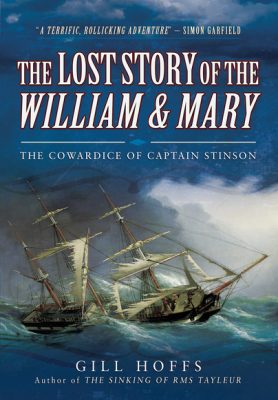
    The Lost Story of the William and Mary: The Cowardice of Captain Stinson by Gill Hoffs (Pen & Sword History, 2016)

    Gill Hoffs book on a nineteenth century maritime disaster has received a number of favourable reviews. This is understandable as it uses contemporary sources to develop the drama as the ship, and its benighted passengers, moved inexorably closer to their doom.

    As an historian of modest claims myself, I welcome the use of resources that modern technology makes available. Books published in earlier times are increasingly being digitised, bringing new – or recovered – insights into otherwise lost events. Similarly, the ever expanding newspaper libraries now coming on stream enable the historian to follow events as they unfolded in the reporting of the day.

    Both sources, of course, are no more certain than books and newspapers of today, and a healthy scepticism, with the realisation that the reports of the day are often incomplete or partial, remain essential elements in the historian’s tool locker.

    At the same time, the expense involved in travelling to dusty archives can be daunting to the professional historian let alone the amateur. Gill Hoffs has made extensive use of the internet to contact descendants of those who survived, and thus access family records and reminiscences, as well as newspapers of the time and a fair range of modern texts mostly of a fairly general nature.

    The story commences with the passengers themselves, as they were leaving various parts of the United Kingdom, especially famine racked Ireland, and the Netherlands. Their travails in the unique culture of the port of Liverpool are followed by details of the only too obvious deficiencies of the ships – British and American – being used to convey, in dreadful conditions, people with hopes of a new life. Conditions for sea-going passengers in the nineteenth century were all too often uncomfortable in inevitably hazardous circumstances, but these ship-owners appear to have been at best thoughtless, at worst utterly heartless, in the paltry arrangements for their human cargoes.

    In a nutshell, the William and Mary was a toxic mix of Roman Catholic Irish and Dutch Protestant emigrants, a crew ill at ease with each other and an incompetent captain, all in a dangerously over-loaded ship. Some childbirths added to the unhealthy conditions, exacerbated by poor rations, lack of privacy and insanitary accommodation.

    As the unhappy ship approached American waters, the captain decided upon an unsafe route through dangerous channels, and the William and Mary paid the almost inevitable price. The real horror of this already alarming story lies in the subsequent events. The captain and the crew, almost to a man, not only abandoned their ship and its passengers to their fate, but also declared on arrival in the United States that the ship had gone down. Newspaper editors wondered how so many of the crew and so few of the passengers had survived, and in due course the dreadful truth emerged. The ship had foundered, but not before many of the passengers had been rescued.

    Gill Hoffs succeeds in developing the dramatic events in breathtaking style, quoting extensively from newspapers of the period. One negative point is that the majority of the reports do not relate directly to the William and Mary. Many indeed pre-date this ill-fated voyage.

    One or two other doubts persist, particularly in relation to context. The Great Famine in Ireland of 1845-8 is well documented, but not well explained here. This concern extends also to the circumstances of sea travel in the nineteenth century, and the specific losses in coffin ships, as they became known, carrying – and losing – vast numbers of destitute and starving Irish peasants to the New World in the mid to late 1840s. Ultimately the problem of overloading ships was remedied by the introduction of the Plimsoll Line in 1876; the absence of adequate regulation is mentioned briefly but could well have been developed further.

    In fairness, these comments detract little from the telling of the story. For the general reader, this is a gripping and fascinating read.

    Barry Jolly is Publications Editor for Milford-on-Sea Historical Record Society, but writes here in a personal capacity.

Latest From Emma's Blog

A History of the Census Takers: Recording the Nations by Mish J Holman (Pen & Sword, 2026)

Looking beyond the census returns to explore the lives and personalities of the people who created them A History of […]

[Read more]

Book Review and Author Interview: A History of Parish Registers in England and Wales: From the Restoration to Civil Registration by John Wintrip (The Lutterworth Press, 2026)

A History of Parish Registers in England and Wales: From the Restoration to Civil Registration by John Wintrip (The Lutterworth Press, […]

[Read more]

Member of The Society of Authors Member of The Association of Genealogists and Researchers in Archives Graduate of the Institute of Heraldic and Genealogical Studies Canterbury Member of the Society of Genealogists Pharos Tutors