
Book Review and Author Interview: Secret Missions Of The Suffragettes: Glassbreakers & Safe Houses by Jennifer Godfrey
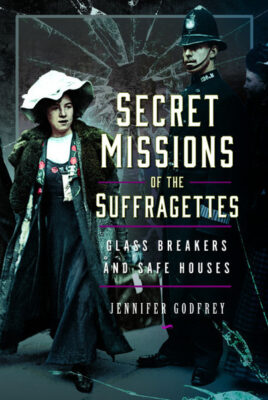
Secret Missions of the Suffragettes: Glassbreakers and Safe Houses by Jennifer Godfrey (P&S History, 2024)
In her latest social history book, Secret Missions of the Suffragettes: Glassbreakers and Safe Houses, Jennifer Godfrey explores the suffragette movement’s clandestine activities during the early 20th century. The narrative focuses on the Women’s Social and Political Union’s (WSPU) window-smashing protest in March 1912, led by Emmeline and Christabel Pankhurst. This protest involved over 250 women who used hammers and stones to smash windows in London as a demonstration against the government’s refusal to include women in their reform bill.
Secret Missions of the Suffragettes details the intricate planning and execution of these missions, highlighting the use of safe houses, rest homes, and the suffragettes’ strategies for evading police surveillance. The narrative also covers the suffragettes’ self-defence training, the use of disguises, and communication through codes and aliases. Throughout Godfrey paints a vivid picture of the suffragettes’ determination and the lengths they went to in their fight for women’s suffrage, while also giving a broad overview of the behind-the-scenes efforts that were crucial to their cause.
This book sheds light on a lesser-known aspect of suffragette history and is essential reading for anyone interested in suffragettes, political movements, or women’s social history.
Interview with Jennifer Godfrey
What was your background before writing this book?
I trained as a buyer and then qualified as a solicitor gaining invaluable research & writing skills that I have transferred to all my subsequent roles including writing books. Most recently I worked for a local district council in their community team working with the voluntary sector and designing, securing funding and delivering projects. This is my second book about the women’s suffrage movement in the UK. My first book, also published by Pen & Sword is called Suffragettes of Kent (published 2017).
Your book explores the “Secret Missions of the Suffragettes.” With so many books, films and documentaries already covering the suffragettes and their cause, how challenging was it to uncover aspects that had stayed hidden or weren’t as well known?
I haven’t found it challenging as I believe there are many untold stories waiting to be discovered and alternative story angles to use. When writing my first book about suffragettes in Kent I came across a young (19-year-old) working-class maid and suffragette called Ethel Violet Baldock. A local newspaper had dedicated a couple of lines to her story of arrest in London. I took this and began searching for more information and as a result was able to contact her granddaughters, great niece and great great niece as well as uncover some limited information in archives. Ethel and her previously untold story have been my inspiration for my books. She was arrested at the 1912 Great Militant Protest as a glass breaker (the mission featured in my second book) and imprisoned in Holloway along with the likes of Emmeline Pankhurst.
It is not just stories of previously unknown suffragettes that are waiting to be told – the opportunity to tell stories about known suffragettes with a different angle or focus is also out there! An example is the approach I chose for conveying the 1912 glass-breaking mission. I wanted to understand how those involved were partnered (i.e. the process including instructions etc.), who they were with and where they went. This opened up a whole new set of questions (i.e. did they know each other before? How experienced at mission activity were they? Who was working behind the scenes pairing suffragettes and giving them stones and hammers? etc.) to attempt to answer which in turn added layers to the known stories whilst identifying some previously untold ones. The Annex in the Secret Missions of the Suffragettes details all those known to have been involved in the 1912 glass breaking and groups them according to when and where they were breaking glass. Interestingly this focus has led to a fantastic opportunity for me to unite the descendants of two partnered glass breakers, Ethel Violet Baldock and Violet Bland. We went to number 1 Northumberland Avenue where Ethel and Violet (known as Annie) had smashed a window 112 years ago.
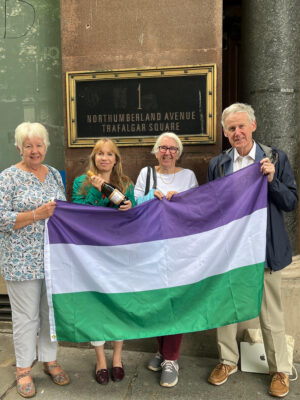 Left to Right: Patricia Radley (Ethel’s granddaughter); Sandra Radley (Ethel’s great-granddaughter); Eileen Bridges (Ethel’s granddaughter); Eamonn Butler (Violet Bland’s great nephew)
Who was the most memorable glass breaker you encountered in your research?
That’s very difficult to answer. If pushed I would say apart from the inspiration for the book, Ethel Violet Baldock, it would be either Janet Barrowman or Lillian Ball. Glaswegian Clerk, Janet Barrowman was 32 and chief clerk at Scottish soap manufacturer, Joseph Watson & Co., known as ’Soapy Joes’. According to the letter sent in by her manager, David Wilkie, Janet had asked for two days’ holiday to see a demonstration in London. Janet had been arrested and charged for smashing a window at the Local Government Board. Like the other glass breakers she had been given a longer than expected sentence. Janet received a sentence of two months and despite David’s attempt to have this reconsidered and reduced she served the full term. As a result, having exceeded her maximum holiday allowance, she lost her job, one which she was extremely accomplished and respected. It is memorable because of her 11 years service to Soapy Joes at a high level (she was often left in charge of the business in Scotland) and the sacrifice she made in taking part in this mission. Her wage was supporting her widowed mother and younger siblings so it was a huge blow. Also memorable was Lillian Ball, a working-class dressmaker from Tooting in London. She gave evidence against Emmeline Pankhurst in the case of conspiracy to incite others and was even cross-examined by the leader in court! After the court hearing, she had to be moved to Reading prison for her own safety.
What’s next for you?
I am currently writing my third book, also about women’s suffrage and again inspired by the youngest 1912 glass breaker Ethel Violet Baldock.
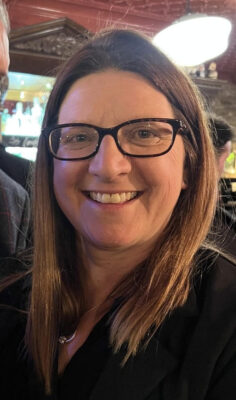
Jennifer Godfrey lives in West Kent with her husband, two children and dog. She is the author of two non-fiction books, published by Pen & Sword Ltd, the first, Suffragettes Of Kent and the recently released Secret Missions Of The Suffragettes: Glassbreakers & Safe Houses.


