
Book Review and Author Interview: Angel Meadow by Dean Kirby
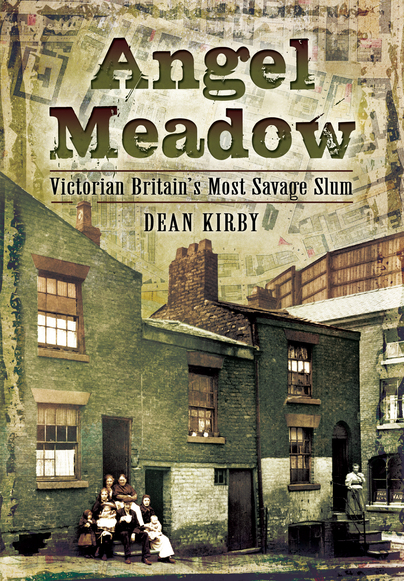
Angel Meadow: Victorian Britain’s Most Savage Slum by Dean Kirby (P&S History, 2016)
Dean Kirby’s immersive exploration of Manchester’s Angel Meadow slum in the Victorian era is a compelling journey into one of the most notorious and dangerous neighbourhoods of the Industrial Revolution. In his meticulously researched book, Kirby, drawing on his journalistic background, vividly resurrects the scenes and characters that define this grim chapter in history.
The book is thoughtfully structured around real events, offering readers a glimpse into the shocking and colourful stories that unfolded in Angel Meadow. Kirby’s dedication to historical accuracy is evident, as he taps into a diverse range of sources, including newspaper accounts, police reports, teachers, missionaries, and magistrates. This thorough approach results in a comprehensive historical record that becomes an essential resource for anyone interested in the lives of those who inhabited this bleak corner of the northern metropolis.
What sets Kirby’s work apart is not only its historical depth but also its connection. This project is a labour of love for the author, inspired by the experiences of his ancestor, William Kirby, a farm labourer who fled Ireland’s Great Hunger only to face the grim reality of the industrial north.
The narrative is enriched with a glossary of Angel Meadow slang, providing a linguistic window into the past, and supplemented by a bibliography, research notes, and a detailed index. These elements contribute to the book’s value as both an engaging read and a scholarly reference.
In summary, Dean Kirby’s book on Angel Meadow is a masterful blend of historical documentation and personal passion. It not only brings to life a vivid and dangerous Victorian slum but also honours the author’s familial connection to the tumultuous events that unfolded in this dark corner of Manchester’s past.
Interview with Dean Kirby
What was your background before writing this book?
I was born and grew up in Manchester and am very proud of the city and fascinated by its history. Manchester was the first industrial city and played a significant role in the creation of the modern world. My dad has always told me stories about Ancoats, the inner city district where he lived as a young lad, and we would spend hours in Manchester Central Library in the 1980s researching our family history – before genealogy was fashionable – using the old, dimly-lit microfilm readers that genealogists used before records were digitised and which were probably really bad for your eyes. After university, I became a journalist and I’ve spent most of my career working in Manchester – going out into communities and talking to ordinary Mancunians about what was happening in their lives – which has given me an even greater appreciation for my home city and its people. The book happened really because these two things – my family history and my passion for the city and its history – came together quite dramatically in 2016.
Your ancestor William Kirby lived in Angel Meadow. Was it solely the discovery of his residence there that inspired you to write about Victorian Britain’s most challenging slum, or were there other motivating factors?
I had been researching my Irish ancestor William Kirby, my 3 x great-grandfather, on and off since those early days in the library with my dad. William was a farm labourer from County Mayo who arrived in Manchester in the 1860s. Like a lot of poor Irish immigrants at that time, he lived with his family underground in a cellar. Using maps, rate books and other records, I eventually managed to locate the site of his house in a car park in Angel Meadow, where I used to park my car because it was convenient for the Arndale Centre. In Manchester, when slum clearances took place after the Second World War, the houses were simply backfilled into cellar holes and sealed over with concrete. As the city centre is largely flat, a lot of that land was turned into surface car parks which are only just now being redeveloped.
One night in 2016, I was walking past the car park where Williams’ house had been with my wife as we went to a Noel Gallagher gig at Manchester Arena and noticed that, amazingly, there was a fence up and a big sign saying “archaeologists at work”. The next day I went back and told them my story. They invited me inside to look at their finds and later let me bring along my dad to climb down a ladder into the cellar holes and touch the bricks of William’s fireplace. They let me take the brick home and I’ve kept it. It still has soot on it from the fire that would have kept him warm on a winter’s day. A death certificate showed that one of William’s children, also called William, died in that house from a fever aged just two weeks old. It says something about the horrible living conditions there, but it also affected the archaeologists, they said, because that’s how long their dig lasted – the same number of days as baby William’s short life.
Visiting the house was a hugely poignant moment for me. As family historians, we all spend our time searching for pieces of paper that will give us a glimpse of how our ancestors lived, but in that moment, we were able to walk right through the front door. That moment inspired me to write the book about the district where William lived and to go on to do a doctorate in urban history – researching the Victorian housing conditions in the same area of Manchester. It means I’ve been researching that small area of the city for a decade now. I’m still very grateful to the archaeologists who didn’t turn me away when I turned up with what must have seemed a surprising story. Instead, they invited me in and encouraged me, and I’m hoping that my PhD study of Angel Meadow’s housing will give something back to them and help them in their own research going forward.
Did you have concerns about portraying some of the distressing stories you encountered during your research?
I did have concerns about portraying some of the distressing stories in the book and there were some that I left out because they were just too unbearable to write about. It was also quite harrowing at times being immersed in those stories during what was four years of research and writing. One story that played on my mind quite a bit was about a woman named Annie Chapman, who was found dead in a privy in Angel Meadow. It’s only a few paragraphs in the book, but her story was so tragic that I thought about her quite a lot while I was writing. One valid criticism of the book was that I didn’t write about the families who lived good, honest lives and never found themselves in trouble with the police or the pages of a newspaper. I totally agree and there’s also an obvious gap in telling the stories of women who lived in working-class districts in the nineteenth century because their stories are often missing from the historical record, or written by men such as police officers and church missionaries who knew nothing really about women’s lives. All I could do, as I was writing about an era which no one is alive to remember, was to use as many different sources as I could find and try my best to portray people’s lives as accurately and fairly as I could. I also felt it was important to treat the people whose stories I was telling with respect and be a voice for them if I was able, as, like my own family who lived in the district, these were real people and the ancestors of modern-day Mancunians. In a way, the book was my attempt to keep alive the stories of those people and to explain what they went through while living in very difficult circumstances.
Who was the most memorable individual you encountered in your research for the book?
There were a few memorable people I encountered in my research and some had interesting nicknames such as Cabbage Ann, the Badger, One-Armed Kitty and Jemmie the Crawler. One thing I enjoyed doing was using genealogy techniques to try to work out the real identities of the people behind the nicknames and find out a bit more about their lives. The Badger, for example, was a thief named John Currie and it was said that he could climb down coal chutes to break into houses. By looking at his prison record though, I also found that his distinguishing marks included his neck being bloated and badly scarred by scrofula, an infection of the lymph nodes caused by tuberculosis. It’s a horrible nickname to have given to someone with a medical condition, but in the days before mugshots and fingerprinting the name would have been a way for police officers to identify him in the street. Cabbage Ann’s real name was Ann Powell and she ran a grocer’s shop and a lodging house. She was a notorious thief trainer who taught youths how to be “breech buzzers” or pickpockets. The most memorable person in my research though was a violent character named Henry Burgess, who would go around Angel Meadow attacking passers-by and the police with anything he could lay his hands on. He had 40 convictions to his name including killing an opponent by throwing a paraffin lamp at him and setting him on fire. I was very lucky to find a photograph of Henry in the Staffordshire Gaol image archive, which is a useful resource for historians searching for Victorian criminals who were transported from the North of England to jails in the South such as Dartmoor, Pentonville and Parkhurst. They would stop at Stafford Gaol on the way and have their photograph taken. It was fascinating to see Henry’s piercing eyes peering back at me in the photograph and to notice that on his neck he had a huge scar, which may have been a knife wound that would have put his life in danger before he was stitched up by a surgeon.
One of my greatest joys in writing the book is that I have been contacted by lots of people who have found their ancestors in the index and have been in touch to find out more information. I was really lucky to chat with one of Henry Burgess’s descendants recently who wanted help with their genealogy research and I was able to pass on some documents and the photograph. They had been unaware of his past until reading about him in the book and it was a real privilege to chat to them after spending so much time thinking and writing about Henry during my own research.
What’s next? Can we expect more books?
Since writing the book, I have been taking an even deeper dive into Angel Meadow by researching my PhD, which I finished last year. I really enjoyed it but I’m keen now to write another Manchester history book. I am currently doing some research. Beyond that, I’ve started a newsletter telling stories from the streets of Victorian Manchester, which is free to join. I’m also in the process of setting up a genealogy business so I can help more people find their Mancunian ancestors and tell their stories.

Dean Kirby is an award-winning investigative journalist whose nominations include being shortlisted for the Orwell Prize for Exposing Britain’s Social Evils for his work on the UK’s fuel poverty crisis. His book on Angel Meadow has been in the Amazon best-seller lists. He now writes a weekly newsletter telling stories from the streets of Victorian Manchester, which can be found at www.manchesterhistory.uk.


