Blog

From 1822, when the Dickens family settled in Camden, to 1860 when the author took permanent residence at his Kent home of Gad’s Hill Place, London was his home.

Emma Jolly, in the article Dickens and London

Emma Jolly writer, historian, genealogist
  1. Book Review and Author Interview: The Malice of Angels by Wendy Percival

    The Malice of Angels by Wendy Percival (SilverWood Books, 2017)

    The reality of life as a genealogist can be quite mundane. I spend most hours in front of a computer, with the odd day out to archives or networking events. In the world of genealogy fiction, however, our imaginary counterparts have eventful lives, regularly being held at gunpoint, taking helicopter flights, or being lured into tunnels by sociopathic clients. Fortunately, my clients are invariably pleasant individuals but the part of me that wanted to be a detective when I grew up wouldn’t mind sharing some of the fictional adventures occasionally.

    I previously blogged about popular genealogical mystery writer, Steve Robinson, and his hero, Jefferson Tayte. Recently, I decided to try the work of Devon-based author, Wendy Percival, and discover the world of her researcher protagonist, Esme Quentin. Wendy has written three books so far, but I chose to begin with the third. The Malice of Angels is a novel based upon the experiences of women in the Second World War – a topic of personal interest to me. I very much enjoyed the book and look forward to reading more by Wendy. I most enjoyed the little-known aspects of the 1940s that Wendy brought into the plot. I also appreciated the intelligent focus on women’s history, as this is still, sadly, an area that is too often overlooked.

    In order to find out more, I interviewed Wendy about the book and her inspirations.

    This is your third Esme Quentin mystery. How long have you been a professional writer?

    I suppose the point at which I became a “professional writer” when the first Esme Quentin mystery, Blood-Tied was published by Robert Hale in 2008. I’d been writing for a few years by then, learning my craft, so to speak. I wasn’t sure then whether there would be more Esme stories but it was clear from the reaction I got from readers that Esme was a popular protagonist so it seemed a good idea to write another. By the time I’d written the second, The Indelible Stain, the world of publishing had changed hugely. The rights of Blood-Tied had reverted to me by then, so I decided to re-publish it as an ebook and paperback, following it with The Indelible Stain the following year and then in October 2017 with The Malice of Angels. In between, I wrote Death of a Cuckoo for SilverWood Books, for their sBooks “short reads” imprint.

    Before becoming a writer, I was a primary school teacher for 20 years. I moved to Devon in 1980 to take up my first teaching post in a small rural school, back in the days when primary education was much more holistic, integrated and inspirational. I left the profession when I could see the way things were heading!

    Much of the plot of Malice touches on the work of female agents of the Special Operations Executive (SOE). I researched some of these agents for my Society of Genealogists’ guide, My Ancestor was a Woman at War. I never fail to be amazed by their bravery, ingenuity and varied skill sets. What drew you to feature SOE in this novel?

    It really started with a local news report about an elderly lady who’d died in Torquay in 2010. To her neighbours, she was someone who, although polite and not unfriendly, kept herself to herself and they knew little about her. But it emerged after her death, that she’d been an SOE, and her name was Eileen Nearne. Something must have triggered a memory of the story a few years later, I really can’t remember what — it was probably WW2 anniversaries and personal recollections reported on the news — which prompted me to read Eileen’s biography, followed by Bernard O’Connor’s book Churchill’s Angels, which systematically logs the experiences, some of them terrifying, of all the women SOEs. What I read inspired several plot points in Malice! I then came across a fascinating book called A Life in Secrets by Sarah Helm about Vera Atkins, who’d made it her personal mission after the war to find out the fate of every SOE she’d waved off to occupied France. It’s a brilliant book. If you’ve not read it, I can thoroughly recommend it.

    Photograph of the coast where The Malice of Angels is set.

    You live in north Devon, where most of this book is set. What appeals to you about this area, both as your home and as a setting for your fictional characters.

    I moved to Devon from the Midlands 38 years ago to take up a teaching post and I’ve never wanted to live anywhere else! For many years I lived and worked close to the North Devon coast so I know it well. I love the wildness of the area I use as the settings for my later books (Blood-Tied was set in Shropshire, where my ancestral “journey” began). I now live right in the middle of Devon, in unspoilt countryside, overlooking a lovely river valley, in a very pretty village with a 13th century Grade One listed church and a cluster of traditional thatched cottages (one of which is ours!). Even the parish hall is thatched! (As you can probably tell, I’m a glutton for old buildings.) It’s a bit further to travel to the north Devon coast these days, but from an author’s perspective, I’ve found it useful to stand back from the place I write about. I think you see it through fresh eyes when you’re not living there all the time. We often take our camper van and stay at the campsite when we need a sea “fix”. The views are magic and the rugged coast is amazing.

    What’s next for you and Esme?

    I promised myself that once Malice was published, I’d give some time to my own family tree and sort out what has become a bit of a chaotic jumble of records and photographs over the years. I also have a few stories about my immediate family I want to write — about my dad who as a child spent 3 years in hospital and was told he’d never walk again but did, about my maternal grandmother who became a professional opera singer at the age of 16 and toured the country’s theatres, about my mum’s recollections of growing up in WW2, including having a bomb drop on to her bed and about the mystery (as yet not completely unravelled) of why my great-aunt walked out of the family home, aged 16 in 1904 and “was never heard of again” until, in her 90s, she was reunited with her only surviving sibling, my paternal grandmother. Not to mention the urge to record my own memories…

    But on the back-burner of the fiction section of my writer’s brain, there is already something brewing for Esme to get her teeth into, so I’m sure it won’t be long before I’ll start plotting again!

     The time-honoured ‘box of old documents in the attic’ stirred Wendy’s interest in genealogy – the inspiration behind her Esme Quentin mystery novels. When not plotting fiction, she’s either digging up her own family history secrets or enjoying the coast and countryside of Devon, which has been her home for the past 38 years.


  2. Photo Restoration Services

    Recently, I was contacted by Nick Harris from Photo Restoration Services offering to demonstrate his skills on some of my old family snaps.

    Increasingly, family historians are using photo restoration companies to repair damaged images digitally and to enhance dull likenesses, thus helping us to discover what our ancestors looked like and even to peek into their world.

    Although there is a variety of image editing software, I have never learned how to use it well. Far easier to email the images and let a professional bring them back to life.

    I sent Nick two photos from my family’s collection. The first was this portrait below of my great, great grandfather, William Jolly (1842-1889).

    The image on the left is the photograph I sent. On the right is the photo that Nick restored. As you can see, the first image has an odd colour, hiding the details of William’s face and the features of the garden. Thanks to Nick’s restoration skills, I can now see my ancestor’s face and the world he lived in far more clearly. The right side of the photograph was less damaged and it is now possible to make out the door handle and bell. It’s disappointing that my relatives left the lace curtains hanging as we may otherwise have been able to see some of the children peering out!

    My family believes this shows my great, great grandfather standing in his Royal Engineers uniform outside his home in Enfield. His bearing in the image suggests his pride in his military career. From a descendant’s perspective, though, I would have preferred to see him without the cap as that is hiding the shape of his face. It is difficult to be certain of the date, but we do know he was overseas from 1880-1885 and he died just fours years later.

    Nick also offers a black and white colourising service which could be used in military photos like the above to highlight the colour of the uniform.

    The second photo (pictured above left) I sent to Nick is more mysterious. No one in the family knows who this is, but I was hoping that if it was enhanced, we would be better placed to identify the sitter. Helpfully, Nick restored not only the portrait, enabling us to better see this young man, but also the details of the photographic studio where the image was taken.

    The photographers, Emberson & Sons, were based at three locations at the date this portrait was taken: Emberson & Sons, 6 Wilton Rd, Belgravia S.W., 57 St. Paul’s Churchyard E.C., and Chertsey, Surrey. According to the Photo London website, the firm was in  6 Wilton Road, Pimlico, Westminster 1885 – 1896, 1904 – 1925; 57 St Paul’s Churchyard, City of London 3 floor 1889 – 1908; and in Chertsey 1873 – 1905.

    We have many London ancestors, but few who lived near Chertsey. This suggests the photograph was taken either in the City or Belgravia (near Westminster) – both central London locations.

    There is so much to explore with old photos and I am in the early stages of poring over my family’s snaps. Restoration is a great way to aid historical photography investigation.

    Based in the Maidstone/ Medway area of Kent, Nick has over 10 years’ photo restoring experience in digital restoration and can be contacted via his website.

  3. Book Review: Tracing Your Pre-Victorian Ancestors

    Tracing Your Pre-Victorian Ancestors: A Guide to Research Methods for Family Historians by John Wintrip (Pen & Sword, 2017)

    Last week I was sent a copy of a new handbook from Pen & Sword publishing. This new guide to researching ancestors before 1837 is aimed at advanced researchers and is the first book by John Wintrip, an established professional genealogist, AGRA member, and holder of the Diploma in Genealogy from the Institute of Heraldic and Genealogical Studies (IHGS).

    Although few at the time may have realized, 1837 would become a key year in the research of family history. Not only was it the year that Victoria became Queen, but it also saw the beginning of civil registration in England and Wales. Four years later, the first national census to record full names, occupations and ages took place.  Throughout the Victorian period, administrators in hospitals, schools, businesses, politics and social policy created and carefully stored records that genealogists use in their research today. Many documents from this period have now been digitised and can be searched easily online.

    Before the Victorian era, however, records were often produced and stored in a less efficient manner and usually on a regional, rather than national, basis. This can lead to researchers finding pre-1837 research more challenging. As a result, Wintrip was inspired to write this guide to meet the challenges and complexity presented by pre-Victorian research. He emphasizes that, “Although sound genealogical research is more demanding than many people realize, it can be made slightly easier with appropriate guidance.”

    In Tracing Your Pre-Victorian Ancestors, Wintrip breaks down the advice into fourteen detailed chapters, covering:

    • challenges of research
    • knowledge and skills
    • sources
    • names
    • social status
    • religion and occupation
    • relocation
    • searching for information
    • archives and libraries
    • evidence and proof
    • family reconstitution
    • missing ancestors
    • mistaken identity
    • help from others.

    Among the strengths of the guide is its focus on methods as well as sources. It does not simply present a list of specific records, but instead focuses on understanding sources better in order to use them correctly. Throughout, Wintrip emphasizes historical context and its importance in family history research of all forms. I also liked the way he identifies why a search may have failed, using case studies, and his explanations on how to improve search methods, indicating practical steps with online services, archives and their catalogues.

    Overall, I am pleased to welcome this book to my family history shelves. Even the most experienced genealogist should agree that in his new work, Wintrip proffers valuable advice for all of us in breaking down our pre-Victorian brickwalls.


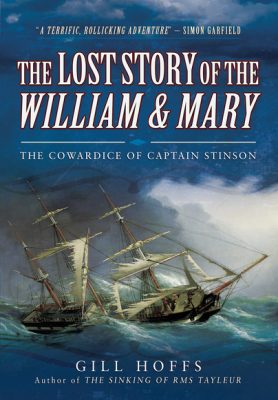
  4. Guest Review by Barry Jolly of The Lost Story of the William and Mary

    The Lost Story of the William and Mary: The Cowardice of Captain Stinson by Gill Hoffs (Pen & Sword History, 2016)

    Gill Hoffs book on a nineteenth century maritime disaster has received a number of favourable reviews. This is understandable as it uses contemporary sources to develop the drama as the ship, and its benighted passengers, moved inexorably closer to their doom.

    As an historian of modest claims myself, I welcome the use of resources that modern technology makes available. Books published in earlier times are increasingly being digitised, bringing new – or recovered – insights into otherwise lost events. Similarly, the ever expanding newspaper libraries now coming on stream enable the historian to follow events as they unfolded in the reporting of the day.

    Both sources, of course, are no more certain than books and newspapers of today, and a healthy scepticism, with the realisation that the reports of the day are often incomplete or partial, remain essential elements in the historian’s tool locker.

    At the same time, the expense involved in travelling to dusty archives can be daunting to the professional historian let alone the amateur. Gill Hoffs has made extensive use of the internet to contact descendants of those who survived, and thus access family records and reminiscences, as well as newspapers of the time and a fair range of modern texts mostly of a fairly general nature.

    The story commences with the passengers themselves, as they were leaving various parts of the United Kingdom, especially famine racked Ireland, and the Netherlands. Their travails in the unique culture of the port of Liverpool are followed by details of the only too obvious deficiencies of the ships – British and American – being used to convey, in dreadful conditions, people with hopes of a new life. Conditions for sea-going passengers in the nineteenth century were all too often uncomfortable in inevitably hazardous circumstances, but these ship-owners appear to have been at best thoughtless, at worst utterly heartless, in the paltry arrangements for their human cargoes.

    In a nutshell, the William and Mary was a toxic mix of Roman Catholic Irish and Dutch Protestant emigrants, a crew ill at ease with each other and an incompetent captain, all in a dangerously over-loaded ship. Some childbirths added to the unhealthy conditions, exacerbated by poor rations, lack of privacy and insanitary accommodation.

    As the unhappy ship approached American waters, the captain decided upon an unsafe route through dangerous channels, and the William and Mary paid the almost inevitable price. The real horror of this already alarming story lies in the subsequent events. The captain and the crew, almost to a man, not only abandoned their ship and its passengers to their fate, but also declared on arrival in the United States that the ship had gone down. Newspaper editors wondered how so many of the crew and so few of the passengers had survived, and in due course the dreadful truth emerged. The ship had foundered, but not before many of the passengers had been rescued.

    Gill Hoffs succeeds in developing the dramatic events in breathtaking style, quoting extensively from newspapers of the period. One negative point is that the majority of the reports do not relate directly to the William and Mary. Many indeed pre-date this ill-fated voyage.

    One or two other doubts persist, particularly in relation to context. The Great Famine in Ireland of 1845-8 is well documented, but not well explained here. This concern extends also to the circumstances of sea travel in the nineteenth century, and the specific losses in coffin ships, as they became known, carrying – and losing – vast numbers of destitute and starving Irish peasants to the New World in the mid to late 1840s. Ultimately the problem of overloading ships was remedied by the introduction of the Plimsoll Line in 1876; the absence of adequate regulation is mentioned briefly but could well have been developed further.

    In fairness, these comments detract little from the telling of the story. For the general reader, this is a gripping and fascinating read.

    Barry Jolly is Publications Editor for Milford-on-Sea Historical Record Society, but writes here in a personal capacity.

  5. My DNA: Living DNA Results

    Recently I was sent a complimentary test by a new British ancestry DNA company, Living DNA.

    The company, based in Frome in Somerset, has just launched in the UK, but is working with experienced mathematical genomicists like Professor Simon Myers of the University of Oxford (one of the team of academic researchers (https://www.gensci.net/) from various UK universities who in partnership with Living DNA developed the autosomal ancestry test) to help interpret customers’ results.

    “This is a whole new approach to DNA ancestry testing, and it is highly personal. No other method – either in scientific literature or in the field of personal genomics – can identify the ancestry of a single person to the level of regions within the UK.”

    Dr Dan Lawson, University of Bristol

    As such, Living DNA claims to have developed the world’s first DNA test which allows people to break down their British ancestry to any of 21 regions in the UK, and that shows how their worldwide ancestry from 80 population groups has evolved over history.

    The 21 regions covered are:

    • Aberdeenshire – Aberdeen and the surrounding areas of Northeast Scotland
    • Central England
    • Cornwall
    • Cumbria
    • Devon
    • East Anglia
    • Ireland
    • Lincolnshire
    • North Wales
    • North Yorkshire
    • Northwest England
    • Northwest Scotland
    • Northumbria – “a unique genetic signature that can be detected within the region today”
    • Orkney
    • South Central England
    • Southeast England
    • South England
    • Southwest Scotland and Northern Ireland – “There is a shared genetic signature for the areas now known as Northern Ireland and the Southwest of Scotland, including Dumfries and Galloway. The areas are divided by a watery barrier, yet historical migrations across the sea have led to a shared genetic legacy between them.”
    • South Wales Border
    • South Wales
    • South Yorkshire


    This test uses the latest GSA Illumina chips, and their algorithms have been developed in partnership with members of the team behind the landmark People of the British Isles study of 2015. Living DNA is keen to stress that this is a geographic test, focusing on where people have lived, rather than on ethnic diaspora/population community groups such as Jewish Askenazi.

    The aim of the project is to show how we are all connected and the company is keen to use DNA testing to help combat racism by demonstrating that race is only socially constructed – there is not genetic foundation for the concept of race. To that end, the company is working in schools on projects with Show Racism the Red Card.

    “Compared to other ancestry tests out there, Living DNA is like viewing your family history on a high definition TV. By combining the latest DNA testing technology with the most robust academic research, we can give users the most accurate picture of their estimated ancestry.”

    David Nicholson, managing director, Living DNA

    Claiming to be the most academically robust on the market, the test does not use admixture but examines the way DNA is linked together. The aim is to bring academic work to individual consumers around the world, including family historians. As the test is new, results will be updated continually and results amended over time. This is particularly the case for areas where samples are currently low, such as with the area of southern Ireland.

    For my test, I did not need to send a DNA sample. I simply submitted my raw data (taken from a prior genetic genealogy test). The test works autosomally, reading from the 22 of the 23 chromosomes that make up each person’s DNA using technology based on the Living DNA Orion chip (comprising software and unique reference databases). Autosomal DNA is inherited randomly from our ancestors, meaning that siblings can show a different inheritance in this test. One brother may have inherited more DNA from a Welsh 4x great grandmother, for example, than his sister. Thus the test provides a unique insight into each individual’s geographic inheritance.

    Map showing the distribution of my DNA.

    Professor Myers told me that while the team is able to quite precisely identify regional contributions within the British Isles, the genetic differences they are identifying are also very subtle. Most people’s ancestors are likely to come from a more geographically diverse set of locations in the 6-10 generation period than are exactly traceable using genealogies. In general, it’s harder to precisely pin down contributions that make up only very small amounts of DNA geographically, because they give less data for analysis.
    On first glance, my results make sense compared with my known ancestry. They indicate that I have 90.7% British Isles DNA, which matches roughly with results from other autosomal tests.
    In comparison, my Ancestry test indicated 85% Great Britain, Family Tree DNA suggests 72% British Isles, while DNA Land has me as 76% Northwest European (which covers Scottish Argyll_Bute_GBR and British in England; Icelandic in Iceland; Norwegian in Norway and Orcadian in Orkney Islands).

    Within the Living DNA’s 90.7% British Isle results, my genetic breakdown is as follows:

    • South Central England 18.2% [update Aug 2017: 19.3%]
    • Central England 14.3% [update Aug 2017: 4.5%]
    • South Wales Border 9.8% [update Aug 2017: 23%]
    • North Wales 9% [update Aug 2017 8.8%]
    • South Wales 7.6% [update Aug 2017: 9%]
    • Northumbria 6% [update Aug 2017: 5.5%]
    • Cornwall 4.7% [update Aug 2017 4.3%]
    • East Anglia 4.4% [update Aug 2017 2.3%]
    • Devon 3.6% [update Aug 2017 2.5%]
    • Northwest England 3.2% [update Aug 2017 2.5%]
    • Southwest Scotland and Northern Ireland 2.6% [update Aug 2017 2.7%]
    • Cumbria 2.6% [update Aug 2017 2%]
    • Orkney 1.6% [update Aug 2017 1.4%]
    • Aberdeenshire 1.1% [update Aug 2017 2.8%]
    • British Isles (unassigned) 1.8% [update -]
    • Southeast England [update Aug 2017 1.3%]

    As I have recently been learning Welsh in order to help with family history research (as well as visits to Wales), I was pleased that, according to these results,  the Welsh contributions adding up to 26.4% indicate that I am 1/4 Welsh. In these results,  the “Welsh borders” also includes some English regions bordering Wales (such as Shropshire where I have known ancestors). However, Professor Myers clarified that usually, Welsh ancestry is not mistaken for other places. 5/32 of my 3x great grandparents were born in Wales. Others may have had Welsh ancestry which has been picked up autosomally. [August 2017 update: my Welsh contribution now adds up to a whopping 40.8%. It remains to be seen how much of this is from the English border counties . . . ]

    Description of the Central region from the Living DNA website.

    Regarding my ancestors from Central England, this area seemed a bit vague. The description references Mercia, which in the past included Staffordshire, Worcestershire, Warwickshire and Shropshire. Of my 32 3xgreat grandparents, 15 were born in this region. The test broadly divides Central England into two zones, one more Northerly and one more Southerly.

    I was a little confused by the definition of the “S. Central England” region (which would also include Gloucestershire, Somerset, Oxfordshire etc.), as I do not have any recent ancestry from those counties. However, Professor Myers told me that Wiltshire, where 2 of my 3xgreat grandparents were born, heavily overlaps and they would expect/hope for ancestry from Wiltshire to be attributed to this region (and sometimes also to S. England). I told him that I had ancestry from Hertfordshire and Bedfordshire, also, and he suggested that this might contribute more to the N. Central England region, but that as these regions are neighbouring and also extremely similar genetically, some overlap is expected.

    Two of my 3xgreat grandparents are from Norfolk and my genetic connection to them has been proven through another genetic DNA test. East Anglian DNA is very similar to that of Germany – indicating that of all the British regions, this is the most Anglo-Saxon. Others contain the presence of Vikings, Jutes, Danes, Normans and, of course, Celts. Although, my East Anglian results are only small here, they fit with the small percentage contributed by these Norfolk ancestors. Professor Myers explained that as my Norfolk-born great, great grandmother, Maria Pymer Jolly, is separated from me by four generations of random inheritance (or non-inheritance), this means I won’t always get exactly 6.25% (the percentage presented by a 2x great grandparent) of DNA from her. She might genuinely have only given me 4-5% of my ancestry – with other ancestors being over-represented instead. He went on to say that the test is not *so* precise currently that the proportions for these small contributions are exactly accurate.

    For me, the oddest results were those indicating that I have ancestry from Cornwall and Devon. I wondered if within the 10 generations, I might have South Western ancestors who moved the relatively short distances north to Wales or Wiltshire. Plymouth in Devon, but on the border of Cornwall, is just 143 miles from Devizes, where one of my 3x great grandmothers was born, for example. Newport in south Wales is just over 60 miles away from Devizes. Professor Myers agreed that this interpretation of local movements seems very sensible, as the test is reasonably confident there is some ancestry from these regions at some point.

    For the 1.8% unassigned (British) ancestry, he explained that this means Living DNA thinks the ancestry is from the UK, but in their evaluation of uncertainty in my results (where they essentially reanalyse my genome after “resampling” its parts, a standard statistical approach) this 1.8% could not be confidently pinned down geographically. After a second look at the data, Professor Myers said his “best guess” for the 1.8% is actually Southern England, which could fit with my Wiltshire ancestry.

    My 2x great grandfather, William Jolly, was born in Montrose, Forfar (now Angus) but his parents were from Kincardineshire, which Living DNA places in Aberdeenshire and/or Northwest Scotland as it falls right at the border of the two different regions). It is possible that the evidence of ancestry in South west Scotland & Northern Ireland, Orkney, Aberdeenshire, and possibly Cumbria, all comes from this part of my family tree.

    There is still more research to be done on my tree by more and more analysis by Living DNA on my genetic data. However, the results so far appear to be a positive start to understanding my British genetic ancestry.

    Living DNA’s test itself is run on a custom-built “Living DNA Orion Chip”. It is one of the first bespoke DNA chips in the world to be built using the latest GSA technology from market leader Illumina, and tests over 656,000 autosomal (family) markers, 4,700 mitochondrial (maternal) markers and 22,000 Y-chromosomal (paternal) markers.

    A lifetime membership to Living DNA costs £120, including a swab kit, the DNA ancestry test itself and access to a personalised, interactive results platform. Test results typically take 8-12 weeks before they are available, and a bespoke coffee table book of the results costs an additional £39 plus postage and packing. A membership also includes free lifetime updates to people’s results as new ancestry research and population groups are added to the platform and as science evolves.

    Update 26 October 2017

    Living DNA sent a press release revealing that their, “One Family One World project is the first of it’s kind to attempt to analyse people’s DNA results from around the world allowing them to see where they fit into a One World Family Tree, demonstrating how everyone is related if you go back far enough in time and produce an in country regional breakdown of DNA from around the world. The project involves the use of proprietary technology, artificial intelligence and machine learning, and will see tens of thousands of computers working together to identify distinctive and shared patterns in people’s DNA. Eventually we will be running in-country regional projects across the world, today people can join no matter where they are from and we already have a number of specific projects that can be seen here – https://www.livingdna.com/one-family/research. You can find out a lot more information on the project, and how to get involved by visiting the website at www.livingdna.com/onefamily.”
    Living DNA goes on to say that, “If you know anyone that’s already taken a DNA test they can upload their DNA for Free and will benefit from a new type of DNA Matching in mid 2018. . . DNA Matching is in final stages of testing for Living DNA clients, we are still aiming to get this live by the end of the year. People taking part and uploading their DNA for free don’t get the regional UK breakdown just DNA matching when live and all the other things that will come out of the project. Therefore it’s not a substitute for a Living DNA test.”

Latest From Emma's Blog

A History of the Census Takers: Recording the Nations by Mish J Holman (Pen & Sword, 2026)

Looking beyond the census returns to explore the lives and personalities of the people who created them A History of […]

[Read more]

Book Review and Author Interview: A History of Parish Registers in England and Wales: From the Restoration to Civil Registration by John Wintrip (The Lutterworth Press, 2026)

A History of Parish Registers in England and Wales: From the Restoration to Civil Registration by John Wintrip (The Lutterworth Press, […]

[Read more]

Member of The Society of Authors Member of The Association of Genealogists and Researchers in Archives Graduate of the Institute of Heraldic and Genealogical Studies Canterbury Member of the Society of Genealogists Pharos Tutors