Blog

I have a personal interest in football history as my great-grandfather’’s cousin, Joe Smith (1889-1971), was one of the best professional footballers of his generation. He is second only to the legendary Nat Lofthouse as Bolton’’s top goalscorer, and his 38 goals in season 1920/21 remain a club record.

Emma Jolly, in the article The National Football Museum

Emma Jolly writer, historian, genealogist
  1. Review of Amelia Dyer and the Baby Farm Murders by Angela Buckley

    ameliadyer

    Angela Buckley is well-known among family historians as the Chair of the Society of Genealogists and for her work on true crime. Her first book, The Real Sherlock Holmes: The Hidden Story of Jerome Caminada (Pen & Sword, 2014) explored crime and criminals through the life of a 19th century Italian-Mancunian detective.

    This latest title is the first in Buckley’s historical true crime series, Victorian Supersleuth Investigates. Focusing on the crime (or in this case, crimes), Buckley carefully pieces together the facts using contemporary reports supported by her research into socio-historical sources.

    Buckley was inspired to explore the crimes of Amelia Dyer when she discovered she lived close to the Reading location where the baby farmer’s victims were found in the River Thames. The true number of Dyer’s victims will never be known, but the book names all those identified through Dyer’s trial, the police investigation, and the rather sensational newspaper reporting of the time. As such, this is a valuable resource for family and social historians. There are details, too, of those who found the victims, along with other witnesses and neighbours.

    One of the mysteries of this case for a modern reader is why did anyone hand over their infants to the murderous Dyer? Buckley provides the background to this, explaining the myriad difficulties in the late Victorian period for women who were unmarried or unable to care for their own children. In my view, the socio-historical detail is one of the book’s greatest strengths.

    Another strength is the lucid writing. Not only is the book easy to read, but the complexities of these crimes and the motivations of the rather puzzling Dyer are explained clearly. Although the subject matter is harrowing, criminal details are balanced against fascinating passages of social history. Despite being full of dates, names and times. the book is short and well-paced. As such it is suitable for anyone wanting to read a book on holiday or during a daily commute. It certainly transports the reader to another world.

  2. Books I Read 2015

    books 2015 blog

    This time last year my New Year’s resolution was to read more for pleasure. As a professional genealogist and writer, I constantly dip in and out of history books, articles, websites, databases, social media links, blogs and historic literature. This repeated skimming of words can become stressful over time. I was concerned my concentration was becoming affected and determined to take time out from snatched paragraphs and screen-reading. Outside work, I am a fan of the Slow Movement. I take long walks, eat organic food and avoid air travel where possible. In 2015, I decided to extend this to Slow Reading. This involved taking time to savour books that I fancied – avoiding those I felt I *should* read – and sitting (or lying) with a paper copy rather than a blue-lit screen.

    I began the year with a Christmas present volume of Ngaio Marsh’s Inspector Alleyn 3-Book Collection 2 including the novels, Death in Ecstasy (1936), Vintage Murder (1937), and Artists in Crime (1938), Australian genealogist Judy Webster recommended these to me as a preferred alternative to Agatha Christie for anyone interested in interwar crime fiction. Like Christie, Marsh focuses on upper-middle class life between the wars. Also like Christie, Marsh was prolific, completing 32 Inspector Alleyn novels. Her protagonist, Inspector Alleyn, is the younger son of a titled Buckinghamshire family.  Marsh’s theatrical background brings plausibility to the murder of a theatre manager in Vintage Murder, but there is an almost televisual eye for detail in each of the three novels. After enjoying all three of these novels, I was surprised not only that Ngaio Marsh isn’t better known but that none of her stories have been adapted in recent years for prime-time television.

    Suzie

    In February, I was delighted to welcome Suzie Grogan to my local Highgate Library for a talk on her latest book, Shell-Shocked Britain: The First World War’s Legacy for Britain’s Mental Health (Pen & Sword History, 2014). inspired by the impact on Grogan’s own family (by her shell-shocked great-uncle’s suicide and murder of an ex-girlfriend in nearby Hornsey in 1922), Shell-Shocked goes further than previous histories in examining the wider impact of war on the mental health of shell-shocked veterans, their extended family, the next generation, and society at large. This enables even those with an extensive knowledge of the Great War to look at wartime experiences (and consequent interwar reactions) in a new light. An experienced writer on mental health issues, Grogan explores the effect of what is now recognised as post-traumatic stress disorder. For decades this was evident only in symptoms such as anxiety or alcoholism. Therapy was minimal: the quiet easing of nightmares and twitches as portrayed in J.  L. Carr‘s 1980 novella, A Month in the Country, remained far out of reach for most veterans. The book also touches on the mental health toll on civilians from new horrors, such as the Zeppelin air raids. The last chapter explores the legacy of shell-shock:

    This book has not set out to establish that war trauma has left an indelible legacy on all families, or on all aspects of modern society. It has sought to highlight, however, the stresses endured by our recent ancestors and to encourage us to examine how our views of their quiet acceptance, silence or reluctance to share may be misplaced.

    A few years ago, in a conversation on Twitter, Jen Newby,  the then editor of Family History Monthly, advised that as I enjoyed the BBC adaptation of Winifred Holtby’s South Riding, I should try the novel. I’ve been meaning to read it ever since. On finally settling down with a copy, I discovered how different it is from the televised version. The book is far more rewarding. Having previously read Testament of Youth, I knew how highly Vera Brittain respected her close friend. On reading South Riding, I discovered why. The novel was published in 1935, shortly after Holtby’s death from Bright’s Disease at the young age of 37. These dates and her young age were in the forefront of my mind as I noted Holtby’s strong empathy with characters from a broad social spectrum. Her remarks on Dachau concentration camp and local government cuts are startlingly prescient. Anyone interested in today’s 21st century socio-economic conditions is likely to be inspired, and perhaps frustrated, by Holtby’s sharp observations on the lives of those administering or affected by the local government institutions of a fictionalized South Yorkshire local authority.

    Both Winifred Holtby and Vera Brittain served in the First World War. Brittain was a nurse with the Voluntary Aid Detachment and Holtby enlisted in the Queen Mary’s Auxiliary Army Corps (QMAAC) in summer 1918. Brittain chronicled both of their services in articles and books. In her new book, Women Heroes of World War I: 16 Remarkable Resisters, Soldiers, Spies and Medics (Chicago Review Press, 2014), Kathryn J. Atwood looks at other notable women and their war experiences and service between 1914 and 1919. Atwood, a writer based near Chicago, explores the lives of 16 women from across Europe and the States, including Edith Cavell, Elsie Inglis, Maria Bochkavera and Flora Sandes, all of whom I touched upon in my latest family history guide, My Ancestor was a Woman at War (Society of Genealogists, 2013). Some of these names are well-known: the centenary of Edith Cavell’s execution, for example, was marked extensively in 2015. Atwood studies each in some detail. Among the portraits, I was struck particularly by the lives of Helena Gleichen and Nina Hollings, radiographers who were hired by Italy but who were shown little respect by their home country. At the time, the Duke of Aosta said:

    We are cleverer than the English then, because we employ who and what we can for our wounded, regardless whether they wear trousers or petticoats.

    Atwood explains further of how, despite Italian support, the women worked in difficult circumstances:

    The women were both given the rank of majors in the Italian army and initially traveled to 11 different field hospitals as well as multiple dressing stations. Their equipment was hooked to as power generator located in their car. They would use it to locate the bullets or pieces of shell that were embedded in the wounded men.

    After the war, Nina and Helena lived together in a large manor “in Great Britain”. They were both awarded the OBE and during the Second World War, Helena organised a Home Defence Corps. She died in 1947, just before her 74th birthday.

    12079078_10153644163376800_5403040423197020849_n

    In October, I attended a talk on the history of swimming in London by Caitlin Davies and Jenny Landreth at a local literary festival, Archway With Words. Davies’ latest social history book, Downstream (Aurum, 2015) is a history and celebration of swimming the Thames. Although I am not a great lover of swimming, I am passionate about celebrating female achievement through history. On this note, I was pleased to discover the remarkable lives of Agnes Beckwith (who in 1875, aged 14, swam 5 miles to Greenwich), typist Mercedes Gleitze and Ivy Hawke. Despite being a celebrity in her lifetime, I was surprised that the feats of Thames swimmer Gleitze have been so quickly forgotten in popular culture. Her 1927 record as the first British woman to swim the Channel stands as testament to her achievements. Beyond swimming, she set up the Mercedes Gleitze Homes for the homeless in Leicestershire using sponsorship and her charity continues. Davies writes:

    Women  . . . were still seen as the weaker sex – physically and mentally – and yet here they were swimming for hours over long distances in the Thames.

    Now we have entered another new year, I have decided to continue with last year’s resolution. Slow reading is enjoyable, relaxing, healthy and educational. My new year’s book, In the Blood, has been recommended to me by numerous genealogists and a copy has been sitting on my shelf for months. A recent newsletter from Lost Cousins prompted me to dust it off, with blogger Peter Calver’s description of Steve Robinson as “one of my favourite authors of genealogical mysteries”. Apparently, Robinson has now sold over 100,00 copies of his debut. Having read the first few chapters I can see why. Fast-paced and with richly-drawn characters, In The Blood is enjoyable and easy to read. Although all genealogists are detectives up to a point, I’m thankful our work isn’t as dangerous as that of Robinson’s protagonist, Jefferson Tayte. The family history research is accurate to archives and sources, but the story is escapist enough to make this a book for leisure and help me maintain my commitment to reading for pleasure in 2016.

  3. Dangerous Characters In London’s Little Italy Fascists, Anti-Fascists, Suffragettes and Spies

    IMG_1683Last week I went to see the latest exhibition at Camden Local Studies and Archives Centre in Holborn and was amazed to learn about a little-known tragedy of the Second World War. The exhibition, “Dangerous Characters in Little Italy” is curated by Alfio Bernabei. Among its exhibits is a section on the sinking of the Arandora Star on 2 July 1940. 805 souls were lost, of which 470 were Italian. It struck me that this is an event that we should commemorate in the way of the Lusitania or other wartime maritime losses. Astonishingly, the exhibition reveals that at the time the event was hidden and little attention was paid to it in the decades that followed.

    Built in 1927, the Arandora Star was originally a leisure cruiser belonging to the Blue Star Line. Recommissioned for war service in 1939, the ship served as a carrier for troops and civilian evacuees. In June 1940, she sailed from Liverpool, transport 734 Italians and 479 Germans who had been interned in Britain to Newfoundland in Canada. Also on board were 86 German prisoners of war and 174 officers and crew. Accompanying them were their guards: 200 Allied naval and military personnel. There was no supporting vessel, indicating that the ship was carrying civilians, and no Red Cross had been painted on the ship.

    Around 100 miles west of Bloody Foreland, Donegal, the Arandora Star was torpedoed by a German U-boat. As the internees clambered into lifeboats, some were shot by their guards to prevent them from escaping. A Canadian destroyer rushed to the scene, managing to rescue 868 lives. In all, 713 internees and 92 guards and crew lost their lives. They included the Captain, E. W. Moulton, 12 officers, 42 crew, 37 military guards, 470 Italians and 243 Germans.

    IMG_1682

    This incident and the silence that followed it, reflected the fear of Italian fascism in Britain during the war. “Dangerous Characters in Little Italy”, first exhibited by Centro Studi P. Calamandrei,Palazzo della Signoria, Jesi, Italy, highlights how fascism grew in Britain’s underground, and how many Italians sought to challenge it. The audio-visual display is based on Bernabei’s research about Italians in Clerkenwell and Soho in the period 1920-1940 and features the rise of Fascism and within the Italian community in London, as well as the activity of the Italian and non-Italian anti-Fascists to oppose it. The exhibition covers the period between the rise of Fascism in Italy in the early 1920s and Italy’s declaration of war on the side of Nazi Germany.

    “Dangerous Characters in Little Italy: Fascists, Anti-Fascists, Suffragettes
    and Spies” is a free exhibition at Camden Local Studies and Archive Centre, 32-38 Theobalds Road, London WC1X 8PA and runs until Friday 3rd July 2015 (Opening Hours: Mon 10-6 Tues 10-6 Thurs 10-7 Fri 10-5 Alternate Saturdays 11-5).

  4. Genetic Genealogy: My AncestryDNA Results

    Genetic genealogy is becoming increasingly important to contemporary family history research. When a paper trail fails us, a DNA test may provide the missing piece to the puzzle of illegitimacy, unofficial adoption, or unclear ethnic origins. Recently there have been well-publicized accounts of foundlings discovering a parent and of others finding biological ancestors previously unidentifiable in historical documents.

    AncestryDNA-kitPaper documents are essential to family history research. The birth/marriage/death certificates, censuses, wills, church records, newspaper reports, and so on tell us (or give us clues about) the identities of our ancestors. But where the “wrong” father’s name is given on a birth certificate, or no clue exists as to parental identity, genealogists can become stuck.

    With improved accessibility and competitive pricing of family history DNA tests over the past five years, the potential of genealogy has been transformed. You may not know the identity of your father, for example, but through DNA testing you could discover a relative of his, or establish his ethnic origin. To this end, AncestryDNA launched its tests in the UK early this year. I received the results of my tests this week and have analyzed them below.

    Autosomal DNA

    There are three main types of DNA test for family history research:-

    • Y-chromosome (Y-DNA)
    • Mitochondrial DNA (MtDNA)
    • Autosomal

    Y-DNA is used to research the paternal line. The test can be taken by males only. The MtDNA test can be taken by men or women but is used to research the maternal line only. The autosomal test can be taken by men or women and tests the DNA inherited from autosomal chromosomes. In a nutshell, this is DNA inherited from all of our ancestors back to our 3rd great grandparents and some of the DNA inherited from ancestors up to the 10th great grandparents. For a detailed account of autosomal DNA see this ISOGG Wiki.

    In family history, we can use autosomal DNA primarily for three aims:

    • to find matches with our genetic cousins
    • to identify our recent ethnic origins
    • to find information on our health.

    The largest companies that provide tests for the first two of the above aims are Family Tree DNA (FTDNA), AncestryDNA, and 23&Me. I tested with FTDNA in 2012. FTDNA provides Y-DNA and MtDNA tests alongside their autosomal test, which is known as Family Finder.

    The third of these aims, health information, is provided commercially by the company 23&Me. Otherwise, raw data from Family Tree DNA and AncestryDNA tests can be uploaded for free to Promethease, but care should be taken with this as no analysis of results is provided.

    AncestryDNA tests only for autosomal DNA. Currently, the company does not offer any Y-DNA or MtDNA testing.

    The AncestryDNA Test

    Taking the test was relatively straightforward. I did have to activate the kit by using Ancestry in Chrome rather than my usual Firefox browser, but other than that there were few problems. Unlike FTDNA, which requires a cheek swab, for the AncestryDNA test I had to spit several times into a vial. I then had to fasten the lid tightly without breaking it – which I found quite tricky. Eventually, I managed it and then posted off to Ireland.

    A few weeks later, I found my AncestryDNA results by checking on the DNA tab on the Ancestry website. Below is the page showing my results. For privacy reasons, I have removed the images of my genetic cousins which sit below the “DNA Matches” heading.

    AncestryDNA main page

    The results are all summarized on this page. On the left is a pie chart showing a broad estimate of my ethnic origins. By clicking on this option the full breakdown is revealed.

    Cousin Matches

    On the right in the screenshot above is the section revealing my DNA matches. The last point on the far right suggests that I have 19 4th cousins or closer. In fact, when I click on these cousins, they are all suggested “4th-6th cousins”. The confidence of these cousins being within this range is only “Extremely High” for one match but “Very High” for the other 18. I have 37 pages of matches. Most are in the 5th-8th range, and are thus difficult to match with my known ancestors.

    DNA tests for family history do not tell you how you are related to a match. You have to work that out for yourself. The test can be used to confirm a relationship with a second cousin, for example, whom you may have found through your family history research or from a shaking leaf on your Ancestry tree. A second cousin should almost always (99% probability) show up as a match in an autosomal DNA test. There is a 90% chance that a 3rd cousin will show up, but far less probability for a 4th cousin. This is because while the two 4th cousins could inherit DNA from their shared ancestor, this may be from different parts of distinct chromosomes. For this reason, care should be taken when using the test to match with those cousins who match distantly on paper. On the other hand, you could find that you share DNA with someone who shares a far more distant ancestor, like a 10th great grandparent. For these reasons, it is helpful to ask as many of your known cousins to test: it is difficult to predict beyond 2nd cousins who will show up in your autosomal DNA matches.

    One of the benefits of AncestryDNA is that, in theory, you can compare the ancestry of your matches with your own ancestry using the Ancestry Family Trees. Unfortunately, this only works if both you and your match have uploaded a detailed family tree . . . and if the corresponding ancestor has been added. Of my “close” 19 genetic cousins, only 12 have added a family tree. Of those 12, 6 have added less than 100 ancestors to their tree. I have contacted 4 of these matches to see if we can find a common link, but have received only one reply so far. This can be one of the frustrating aspects of genetic genealogy.

    On the FTDNA website, you can use phasing to work out the possible branches on which you match your relative. Below is a screenshot from my Family Finder matches showing the option to click on “In Common With”. After clicking this, a list of all the cousins who match with this relative (in this example, it is my father) will appear. Family Finder also includes details of the number of shared centimorgans (cM) and a chromosome browser which reveals on which chromosome(s) you are connected to each cousin.

    FamilyFinder pageIn contrast, AncestryDNA has a “Most Recent Common Ancestor” feature. When you review your matches you will see whether some of the proposed cousin matches have trees attached to their results. Once you click into this (provided they have made their tree public), you will be able to see a list of common surnames across both your tree and theirs.

    DNA CirclesLinked to this, Ancestry has a “DNA Circles” section to identify another user who is a DNA match and has the same ancestor in his/her tree. Using the circles you can add a third person who also has matching DNA, or a fourth. The idea behind this is that it is more likely that you’re all related because you’re descendants of a particular ancestor. However, as you can see from the screenshot of my Ancestry results above, I am yet to be included in any circles.

    Another feature for finding common ancestors is the maps and locations tab which allows you to find matches using a location perspective (i.e comparing the people in your tree versus your potential matches).

    So far, it seems that AncestryDNA has good potential for identifying my genetic cousins. One oddity I have found concerns a match who appears in both my Family Finder and my AncestryDNA matches lists. He is clearly the same person as not only does he have the same name, he has exactly the same photograph. For privacy reasons, he shall remain anonymous here, but what is notable is that on Family Finder he is identified as a 2nd-4th cousin, whereas on AncestryDNA he is only a suggested 5th-8th cousin. There is a big difference between the two. I have been in email contact with this cousin but we are yet to prove the link between us. Until then, it is uncertain whether Family Finder or AncestryDNA is the more accurate in measuring our cousin relationship.

    Ethnic Origins

    Family Finder estimates that my ethnic origin is 87% European. This is broken down into 72% “British Isles”, 10% Eastern European, and 5% “Western and Central Europe”. 

    Regarding my European origins, Ancestry identifies me as having 85% from “Great Britain”. Separately from those, 5% is “Irish”. In the Ancestry test, “Irish” is regarded as separate from British ancestry. From Y-DNA testing we know there is some Irish ancestry on my Scottish JOLLY branch. However, contrasting this with the paper trail suggests that 5% may be too great an estimate. Nevertheless more work needs to be done on this and it is possible that there is Irish ancestry on one or more other branches of my tree.

    Conclusion

    For DNA tests to be useful for family history research, more people are needed to test. The larger the pool of testers, the more likely it is that those of us who have taken tests will find matches. As shown by both Family Finder and AncestryDNA, most of my ancestors in the past 15 generations are from Great Britain. It is probable, therefore, that I will match with more testers if they or most of their ancestors originate in Britain. That AncestryDNA has only recently launched in the UK is exciting for users like myself. I am looking forward to finding more matches over time as more Britons take the test. I just hope that when they do, they take the opportunity to add as many ancestors as they can to their Ancestry trees and that they respond to online messages.

    On that note, if anyone reading this blog recognizes me in their matches on either Ancestry or FTDNA, I would be very delighted to hear from you!

    In this post I have touched only briefly on the very complex science of genetic genealogy. For a clear and comprehensive account of family history tests and the genetics behind them, I recommend Debbie Kennett’s DNA and Social Networking (The History Press, 2011).

    UPDATE APRIL 2016

    Since I posted this, I have received two Ancestry DNA “hints”. These are indicated in the DNA section of my Ancestry profile by the shaking leaf symbol. In the examples on my profile (see screengrab below) the two matches were suggested to be a 4th cousin and a “distant cousin”. Ancestry user names have been removed from the screengrab below to protect privacy.

    Hints page Ancestry DNA

    Both of these Ancestry users have proved to be identifiable cousins thanks to the information in their (and my) online trees. As you can see in the above image, both of my newly-found cousins have high numbers of people in their online Ancestry trees. I also have several thousand people recorded in my Ancestry tree. Using the information we have inputted, the Ancestry DNA technology was able to identify our mutual ancestors (as shown in the screengrabs below).

    This screengrab shows that my match here was correctly identified by Ancestry as my 4th cousin. We share Norfolk ancestors, Clark Pymer and Ann Oxborough.

    Update Ancestry DNA Mar 2016 screengrab


    Ancestry DNA blog update

    The second screen grab shows that this ancestor, Emanuel Billingham (1750-1837), is further removed from my cousin and me. Here Ancestry is able to identify that my match is my 5th cousin 1x removed.

    I was hoping that there would be a way of confirming that these two Ancestry users were my cousins, as there is on FTDNA. Unfortunately, the only method appears to be through the Ancestry DNA Circles I mentioned above. In order to create an Ancestry DNA Circle (or for one to be created for you), there needs to be three confirmed matches. So far, I only have two for each ancestor.

    Thanks to Debbie Kennett for pointing me to this Ancestry DNA blog which explains in detail the requirements for Ancestry DNA Circles: http://blogs.ancestry.com/ancestry/2014/11/20/new-ancestrydna-technology-powers-new-kinds-of-discoveries/

    UPDATE 17 September 2020

    Ancestry sent the following statement alongside the update:

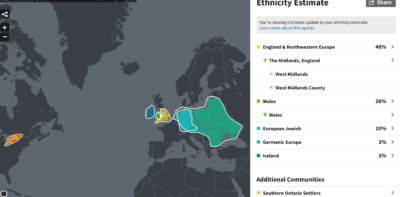
    As you may know, we’re constantly evolving the technology and methods behind AncestryDNA®. Using a combination of scientific expertise, the world’s largest online consumer DNA database, and millions of family trees linked with DNA results, we’re releasing our most precise DNA update yet. With this latest update, you’ll notice that we now have four regions in the UK and Ireland, rather than two; England & Northwestern Europe, Wales, Scotland, and Ireland. Because the DNA from our reference groups in Scotland and England are so similar, it’s possible that if you have English ethnicity, particularly northern England, you may now find an increased percentage of Scotland in your results and vice versa.

    On the whole, my ethnicity breakdown is similar to how it was before this latest update. The Welsh content fits with my known ancestry on both my paternal and maternal sides.

    However, as the JOLLY line is all Scottish prior to 1876, I would expect to be 1/16 Scottish. I was surprised to see my small Scottish percentage has now disappeared. It appears to have been replaced by Irish ethnicity. Interestingly, a Y-DNA test indicated that there may be Irish origins. However, they would only be on the Jolly line itself – not on all the other lines within Scotland.

    It seems to me that the Irish and Scottish ancestry has merged slightly in this latest update. I expect the next update to revert to some Scottish ancestry for me.

  5. My Great Great Grandfather and the Great Confectionery Swindle of 1911

    Criminal ancestors may have been a source of shame to our families in the past, but for today’s family historians their antics have created many useful and well-archived documents. Court records and newspaper crime reports are particularly rich seams of material for researchers. Searching online, I was delighted to discover my great great grandfather’s appearance in an Old Bailey court proceeding from 1911.

    Thankfully, my ancestor Henry Joseph Barnes (known to his family as “Nen”) wasn’t in the dock. Instead, he had a small part in the misappropriation of a large collection of sweets by 37 year old clerk, John Stone. At the time, Nen was working as a carman for Thomas Handyside Ltd of Holloway Road, manufacturing confectioners.

    From the census, taken two months before this trial took place, I know that in 1911 Nen was living in Boleyn Road, Islington and that his sister lived just north of there in Allen Road, Stoke Newington, where some of the following events took place.

    Old Bailey Proceedings, 27th June 1911. Reference Number: t19110627-43 The full account can be found online at the website, “Proceedings of the Old Bailey: London’s Central Criminal Court 1674-1913”

    STONE, John (37, clerk) , obtaining by false pretences from Thomas Andrews two hundredweight in weight of mixed caramels and other articles, the goods of Nathan Baras Walters, from William Mason, a quantity of confectionery, the goods of Simon Flatto, and from Henry Joseph Barnes five hundredweight in weight of confectionery, the goods of Thomas Handyside Limited, in each case with intent to defraud: attempting to obtain by false pretences from Frederick Charles Wimble a quantity of chocolate, the goods of F. L. Cailler; from Walter George Scott a quantity of chocolate, the goods of Jean Bear, and from Frederick Nettleton one ton of cocoa shell powder, the goods of Frederick Nettleton and others; (forging and uttering and publishing as true a certain writing purporting to be a business reference from Jacob Mehlburg, with intent to defraud).

    Mr. Walter Frampton and Mr. Roome prosecuted; Mr. E. H. Coumbe defended.

    Mr. Coumbe objected to the indictment as charging a number of separate misdemeanours followed by two counts charging forgery and uttering; the prosecution should be put to election as to which count they go upon.

    Judge Rentoul said that he had some doubt as to including the last two counts; evidence of similar acts of obtaining by false pretences could always be given even where not a part of the indictment; the first eight counts were unobjectionable.

    The last two counts were struck out.

    FREDERICK CHARLES WIMBLE , assistant manager to F. L. Cailler, 4, Upper Thames Street. On March 6, 1911, I received letter (produced) from “J. Stone, tobacconist and confectioner, 69, Allen Road, Stoke Newington”: “Dear Sir,—I have for some time dealt with Nestlé and Co.,” ordering a quantity of sweets and giving reference to Bond and Co., 110, Matthias Road, and Bloom Stores, Brick Lane. I wrote the letter (produced) of March 11, stating that on receipt of cheque the goods would be forwarded. On March 13 prisoner telephoned, saying that he was surprised at receiving a pro forma invoice, and asking if the references were satisfactory. I told him the references were satisfactory, but they were not in our trade, and as it was his first transaction we should prefer to have a cheque. He replied: “There is no difficulty about that. I will send you a cheque, but I must have the goods on Wednesday morning without fail.” That was on Monday at 11 a.m. After 4 p.m. I received letter (produced), post-marked “2.15 p.m.,” containing cheque for £10 1s. 6d. The following morning I had the cheque specially presented; it came back dishonoured. I wrote expressing surprise and stating that on receipt of the cash the goods would be forwarded. I heard nothing further from the prisoner.

    Cross-examined. My firm is a member of the Confectioners’ Alliance, whose solicitors appeared at the police-court. We did not prosecute, but I appeared as a witness.

    WALTER GEORGE SCOTT , chief clerk, chocolate department, Nestlé’s Anglo-Swiss Milk Company, owned by Jean Bear. On March 6, 1911, I received letter produced from prisoner ordering goods and referring to Bond and Co. and the Bloom Stores; I forwarded pro forma invoices of £7 1s. 9d.; prisoner sent cheque, which was returned marked “R/D.” I wrote expressing surprise and heard nothing further. I did not part with the goods.

    NATHAN BARAS WALTERS , 122, High Street, Poplar, manufacturing confectioner. On March 15 I received letter produced from prisoner ordering sweets to the value of £5 11s., which I sent with invoice, when the carman brought me cheque produced, which has been returned marked “R/D.” I informed prisoner, who wrote that it was owing to a cheque of £8 9s. 10d. paid into his account being dishonoured and stating he would write when we could present it again. I have not been paid.

    THOMAS ANDREWS , carman to N. B. Walters and Co. corroborated.

    HENRY HANDYSIDE , managing director of Thomas Handyside, Limited, 166 and 167, Holloway Road, manufacturing confectioners. On April 3 I received letter produced from prisoner ordering goods. I wrote with invoice stating the goods would be delivered for cash, on April 6 sent them by my carman and received cheque for £4 14s. 6d. produced, which has been returned marked “R/D.” I informed prisoner, applying for the money and received no answer.

    HENRY JOSH. BARNES , carman to Handyside, corroborated.

    SIMON FLATTO , trading as the Anglo-Russian Confectionery Company, received similar order, sent goods and received cheque for £5 2s. 4d., which was returned marked “R/D.”

    WILLIAM MASON , carman, corroborated.

    FREDERICK NETTLETON , of Nettleton and Morris, 8, Colonial Avenue, E.C., confectionery merchant. On April 19 my firm issued a circular recommending cocoa shell powder to confectionery manufacturers; it is an article only of use to manufacturers. On April 24 I received letter from prisoner asking for quotation, which we sent, and on May 2 received letter produced ordering one ton and giving references to Bond and Co. and to J. Mehlburg, of 193, Whitechapel Road (to whom we had sent a circular). I wrote to both references and received letter produced purporting to come from J. Mehlburg stating that prisoner was good for £20 credit.

    Mr. Coumbe objected to the evidence as embarrassing to the prisoner and as tending to bring in the charge of forgery.

    Judge Rentoul held that this evidence was admissible as evidence of false pretences.

    (Examination continued.) I believe the letter from Mehlburg to be genuine, but after making other inquiries wrote prisoner offering to send the goods on receipt of cash. On March 17 I received letter with cheque for £10 (produced), which was paid into my bank and returned marked “R/D.” I paid the cheque in again with the same result. I wrote prisoner asking for an explanation, but received no reply.

    Cross-examined. I do not know J. Mehlburg and have had no dealings with him; my circular was sent to him as his name appeared in a list of confectioners.

    JACOB MEHLBURG , 193, Whitechapel Road, confectioner. I have known prisoner seven or eight years; he was a clerk to a solicitor and used to collect money and write letters for me. About seven or eight months ago he opened at Allen Road and had £3 worth of goods from me for which he paid. On Saturday, March 11, he asked me to change a cheque for £10 for him. I said if he would call on Monday morning if I had the change I would do so. On the Monday he called, but I had not the money. He said could I get the bank to change it. I said no, he had better open a small banking account. I then introduced prisoner to the London Provincial Bank, Whitechapel Road, where he opened an account and received a cheque book. Prisoner used to call on me once or twice a fortnight. I do not know Nettleton and Morris, have never written to them or authorised anyone to do so. I did not write letter produced or ask anyone to write it for me. It is written on my notepaper.

    Cross-examined. I have been 11 months at 193, Whitechapel Road, and formerly carried on a confectioner’s business at 14, Vallance Road. My wife and family assist in the business when I am out. I am an Austrian and have been 12 years in England. I occasionally deal in job lines in confectionery; I have bought three lots from prisoner for which I produce receipts: April 8, £9; March 31, £6 12s.; March 21, £8 0s. 3d. I did not buy goods to value of £4 9s. 8d. from prisoner in May. I have had no dispute with the Confectioners’ Alliance. I had no occasion to buy through the prisoner from Nestlé or Cailler—I have bought direct from those firms. Cocoa shell powder is of no use to me, as I do not manufacture. I do not know what it is good for. I never told prisoner I would buy some from him. I take about £140 a week in my business. I deal wholesale, buying from manufacturers and supplying small shops. I do not owe prisoner any money for goods supplied. I do not know who wrote the letter to Nettleton produced. Prisoner may have written letters for me years ago. I always sign my letters myself.

    Re-examined. Prisoner has visited me at Vallance Road. Letter produced is written on Vallance Road notepaper and is signed, “J.

    Mehlburg.” I always sign “Jacob Mehlburg.” It is not my brother’s or my traveller’s writing.

    DAVID WETTMAN , Wettman and Co., 19, Osborn Street, E., wholesale confectioners. In May last I received an order from a Mr. J. Stone for 4 cwt. of sweets, coming to £4 19s. 6d. I have mislaid the order. They were to be delivered to his place, Allen Road, Stoke Newington. My carman took them and brought back a cheque for the amount of the bill. This is it, signed J. Stone, and dated May 12. I paid it into my account, and it was returned. I went to see the prisoner, and his wife told me to pay the cheque in again, the money was there. I paid it in again, and it was returned. Prisoner kept a little shop; I did not see any of my stock there. I have received nothing for the goods. Mr. Coumbe said he did not challenge any of the deliveries.

    JULIUS EARET , J. Karet and Co., 38, Bridge Street, Mile End, wholesale confectioners and manufacturers. We received this latter, dated March 21, from J. Stone, Allen Road, Stoke Newington: “I have been dealing with the British Confectionery Company, and on recommendation wish to give you a trial. Please forward 2 cwt. of French nougat, 1 cwt. of chocolate nougat, 1 cwt. of nougat cubes, 1 cwt. of Jap desserts. Please advise when you are delivering.” I told my clerk to book the order, and mark it “C.O.D.” I delivered the goods on March 23. They came to £4 6s. The carman brought the goods back as there was no cash to meet them. On March 24 I received this letter from Stone: “Dear Sirs,—I regret I was not in when goods arrived. Kindly deliver to-morrow, Saturday, and oblige.” I sent them, and the carman brought back a cheque on the London and Provincial Bank, Whitechapel, for £4 6s., signed “J. Stone.” I paid it into my account, and it was dishonoured. I went to the prisoner’s place and saw a woman I believe to be Mrs. Stone; she insulted me. I have never had my money nor the goods back. It was a very little shop there.

    RICHARD WILLIAM HUMPHREY , clerk to London and Provincial Bank, Whitechapel Road. We have a customer named Jacob Mehlberg. On March 13 last he brought Stone to the bank. Prisoner opened an account with a cheque for £10 13s. 9d., and signed the signature book. These cheques (Exhibits 1, 5 to 13) are all signed by Stone. The cheque prisoner opened the account with was returned dishonoured; it has not been paid. The cheque was never paid in again. Our cheque-book was not returned; we applied for it.

    WALTER FREDERICK SISMAN , clerk to London and Provincial Bank, Limited, 167, Whitechapel Road. I produce a certificated copy of the account of J. Stone, Allen Road, Stoke Newington. It was opened on March 13 by a payment in of a cheque for £10 13s. 9d., and a cheque-book containing 24 cheques was handed out on that day to Stone. The account is debited with 2s. for it. The cheque for £10 13s. 9d. was returned dishonoured on March 17. On that date a cash payment was made of £2. A cheque was drawn against that on the 20th for £1 10s. The next payment into that account was on March 20 by a cheque for £8 19s. 10d. It was returned dishonoured on the 24th. It was paid in again on the 24th, and returned again dishonoured on the 28th. That was the last payment in. The only effective payment in was £2. At the last there was 6d. to the credit. On March 14 there was a cheque in favour of Cailler’s British Agency, resented for payment for £16 1s. 8d., which was dishonoured. On the 15th one in favour of Nestlé’s for £7 1s. 9d. There were sixteen other cheques presented for payment in favour of different people, all of which were dishonoured because of no funds to meet them. There was an effective payment into the bank to the credit of the account of £2, against “which cheques for £96 13s. 7d. were drawn. On April 3 a letter was written to Stone, asking him to close his account and return the unused cheques. They were not returned, so far as I know. The cheque-book contained 24 cheques; 19 were drawn.

    Cross-examined. We should not hear whether any of these cheques had been taken up by him.

    Detective-sergeant ERNEST BROCK , M Division. I arrested prisoner on a warrant at 69, Allen Road, Stoke Newington, on May 23. I read it to him. He made no reply. He was charged and made no reply. I searched the premises. There was no telephone there. The telephone number on the billheads, “1212 Dalston,” is at a public-house next door.

    (Defence.)

    JOHN STONE (prisoner, on oath). I am 37 years old, and have been a solicitor’s clerk practically all my life. Of late I have been managing clerk to Mr. G. Edgar Mew, practising in the East End. I first went to him in 1907, and left in September, 1910; his practice was not particularly successful, and he gave up. I then went to Mr. Richards, 1, Great James Street, Bedford Row, and was there for about six months. While with Mr. Mew I became acquainted with a Mr. Winfield. He wanted to sell a shop, and I bought it for £10. My wife looked after it. I was occupied in legal business right up to the time of my arrest. The confectionery business took from £7 to £10 a week gross at first, and then it fell off to about 30s. a week. At first I always paid spot cash for goods supplied for the business up to March this year. About the beginning of last March I was not in regular employment. I had known Mehlberg for years through doing legal business for him. He knew I had taken this shop. I told him I wanted to get further stock cheap, as the takings had gone down, and he said he could give me the names and addresses of firms where I could get cheap goods and credit, and give his name as a reference. I went with him to the bank and opened an account. Early in March I had a good deal of money owing to me from Mr. Nunn and Wilson’s Electric Empires, Limited. Mr. Nunn is managing director of Wilson’s Electric Empires. I have done a lot of work for him and for the company as secretary and confidential clerk. My belief in March was that I was going to be paid, and I should then have money. Cailler’s and Nestlé’s names were given to me by Mehlberg. He said to me, “If you pay cash terms you get a good percentage, 10 or 12 1/2 per cent., and I can afford to give you a very small profit, and then can resell again and get my profit over you. If you give these first orders you can get a month’s credit, and then you will get a certain amount of discount.” This was in the middle of March. In consequence I wrote the letters to Cailler’s and Nestlé’s. The cheques to them were sent on the day I opened the account. I fully anticipated the cheque for £10 13s. 9d. being met. As to the £23, if I had received these goods I would then have arranged with Mehlberg to buy them at a profit, and I should have immediately paid that money into the bank. Even if my cheques had gone back I could have gone to the payees’ banks on the following morning and have picked them up. I say that Mehlberg’s denial of any such contract is a deliberate untruth. What I wrote to Cailler’s is perfectly true, that I had for some time dealt with Nestlé’s. I had not dealt direct with the firm, but with their goods. As regards Walters, Handysides and Flatto, when I knew the £10 13s. 9d. cheque had been dishonoured I saw Mr. Nunn, and he said, “You must hold that cheque over.” I fully believed the cheque for £8 19s. 10d. would have been met. At that time I was expecting daily to receive £45, and acting on that belief I ordered these goods. As regards the other goods during March and April, Mehlberg had arranged to pay me, bat he did not do so promptly. I received some money from him, and paid current accounts. The cheques drawn to the Stoke Newington Borough Council and Metropolitan Water Board I tore up and paid cash instead, out of the moneys I received. If I had received sufficient cash from my debtors I should have picked up all these cheques and should have had a balance in hand as well. That was absolutely my intention from the beginning. The three firms dealt with in May were all well known to Mehlberg. He said to me, “You will get the goods from those people, I will buy them from you and you can pay them in to meet your cheques,” which I was going to do. I let him have the goods I received from the Maple Confectionery Company. He owes me the money for them to this day.

    (Saturday, July 1.)

    JOHN STONE (prisoner) recalled. On May 15 by a friendly arrangement a receiver on behalf of a debenture holder was appointed of Wilson Electric Empires, Limited. My claim was sent in then for £47 19s. 10d., of which £38 was a preferential claim for arrears of salary and admitted. Mr. Wilson is at Bath at present. The reference sent to Messrs. Nettleton and Morris came from Mr. Mehlberg. He requested me to write to them and order a ton of cocoa shell at the price quoted in a circular he gave me and he would give me a sovereign profit, the arrangement being that if I got that they would then give me credit and I could get five tons and he would be able to sell it. The letter from Mehlberg’s looks like his brother’s writing. I do not think he can write Englsh. I have written many letters for him and signed his name to them. Other people have done so as well. I wish to make an offer to assign to a trustee, on behalf of the prosecutors’ debts owing to me amounting roughly to about £72. I say the total of the goods I have had delivered to me is about £33 or £34. The thought never entered my mind of defrauding any one of these persons of their goods or their money.

    Cross-examined. I have been a solicitor’s clerk for 23 years and according to my circular the proprietor of a legal agency, but there was very little in it. I know from my legal experience that Criminal Courts will not listen to such a suggestion as I made as to paying these people, but it was a suggestion of mine. The evidence they have given (excepting Mehlberg) I agree is true as to my ordering the goods, but I do not say it is true they wanted cash for them. I left my cheque book at home signed, and if they asked for payment when delivering the goods they were to be asked if they would accept a cheque. I anticipated the delivery of the goods on the usual terms, one month. I say I had a perfect right to draw on the bank. Whether I had or not, unless there was money there to meet the cheques, is a matter of opinion. Many people draw cheques in anticipation of getting money in time to meet them: that is finance. This is a question of finance: I anticipated money. I did not wish the people to believe that money was at the bank at the time nor that I did not have a farthing there; I always had something. I never had more than £2 in the account. With the exception of that £2, against which 30s. was drawn a few days afterwards, and 2s. charged for a cheque book and two dishonoured cheques I received from Wilson and Nunn, I have unfortunately not paid a farthing into my account. When you asked whether when I applied to Messrs. Cailler and Nestlé for goods I mentioned that I was dealing with a rival house you are putting it very broadly. I said to Cailler’s that I was dealing with Nestlé’s and to Nestlés that I was dealing with Cailler’s. Mr. Nunn used to call himself Wilson. I have known him for seven or eight years. He is an undischarged bankrupt. He obtained credit far over £20 without disclosing the fact, was prosecuted and acquitted. He brought an action for malicious prosecution, which he lost. He has not paid any of the costs. I was a witness and managing clerk to his solicitor. I knew his position early this year. I acted for him in a matter of rates. That is the gentleman whose cheque I was accepting to open an account at my bank on March 17. I certainly thought it was going to be met. It was not a shock to me when I found it dishonoured; I have had a good many dishonoured. Although it was that day I drew cheques for £16 to Cailler’s and £7 to Nestlé’s I had every wish to meet them.

    Re-examined. Mr. Nunn has an action against the Bioscope Company still proceeding for breaches of agreement in which he claims £1,200. I know they made him an offer of £100 and costs, which he refused and then he brought the action for malicious prosecution.

    Mr. Frampton. That action has been discontinued.

    Mr. Coumbe. We do not know that. (Evidence continued.) Wilson has paid hundreds of pounds to big firms in the picture business, but his expenses were very heavy.

    Verdict, Guilty.

    Sentence, 12 months’ hard labour.

    BEFORE MR. JUSTICE DARLING.

    (Saturday, July 1.)

Latest From Emma's Blog

A History of the Census Takers: Recording the Nations by Mish J Holman (Pen & Sword, 2026)

Looking beyond the census returns to explore the lives and personalities of the people who created them A History of […]

[Read more]

Book Review and Author Interview: A History of Parish Registers in England and Wales: From the Restoration to Civil Registration by John Wintrip (The Lutterworth Press, 2026)

A History of Parish Registers in England and Wales: From the Restoration to Civil Registration by John Wintrip (The Lutterworth Press, […]

[Read more]

Member of The Society of Authors Member of The Association of Genealogists and Researchers in Archives Graduate of the Institute of Heraldic and Genealogical Studies Canterbury Member of the Society of Genealogists Pharos Tutors