writer, historian, genealogist

  • Home
  • Books
  • Research
    • Research Options
    • Genealogy Research Request
  • Consultations
  • Teaching
  • Media
  • About
  • Blog
  • Contact

Blog

Whilst writing a book on tracing ancestors in British India, I explored the character and actions of one of the most notorious Britons in India, Robert Clive (1725-1774).

Emma Jolly, in the article The Urban Genealogist on Holiday: The Clive Collection at Powis Castle, Wales

Emma Jolly writer, historian, genealogist

Category Archives: Genealogy

  1. Genetic Genealogy – Biogeographical Ancestry

    March 29, 2025

    Biogeographical ancestry (BGA) is now the preferred and more accurate term for what DNA testing companies have traditionally called “ethnicity.” Another commonly used term is BioAncestry.

    Until recently, genetic genealogists—including myself—referred to these findings as “ethnicity results.” To align with current terminology, I am updating this blog with the preferred terms and sharing my latest results.

    The five most popular DNA testing sites for ancestry and health insights are AncestryDNA, 23andMe, MyHeritage DNA, FamilyTreeDNA, and Living DNA.

    Ancestry

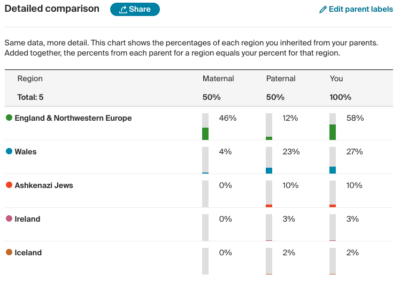
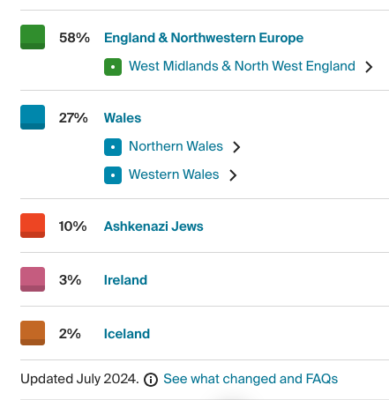
    Ancestry’s most recent BGA update was in July 2024, and my results align well with my documented family history.

    I was especially pleased to see the West Midlands highlighted, as this is where most of my maternal ancestors lived in recent centuries. The Welsh ancestry reflects both my paternal and maternal heritage, while the 10% Ashkenazi Jewish matches what I would expect from my great-grandfather.

    The 3% Irish may be linked to either my Scottish or West Welsh ancestors, but the Icelandic component appears to be an anomaly—I suspect it will disappear in the next update.

    23andMe

    Like Ancestry, 23andMe has accurately highlighted my West Midlands heritage. Even better, it identifies my mitochondrial haplogroup as T2b, which aligns with my known ancestry.

    23andMe categorizes my Ancestral Composition as European, further dividing it into Northwestern European and Ashkenazi Jewish, with percentages that match my documented family history.
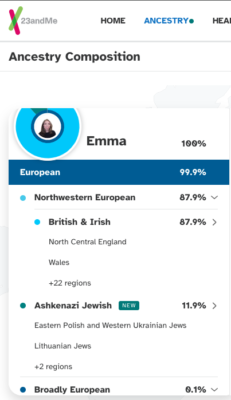
    One advantage of 23andMe is its detailed regional breakdown beyond just the West Midlands. It identifies four distinct British regions in my ancestry:

    North Central England

    Defined as “north central England and parts of the West Midlands, including Staffordshire, Leicestershire, West Midlands, Cheshire, and Derbyshire.”

    • Common maternal haplogroups: H1, T2b, and H1c.

    • Since my maternal haplogroup is T2b, this fits well with my ancestry.

    Wales

    Defined as “Wales and England’s Welsh border counties,” which includes parts of the West Midlands.

    • Common maternal haplogroups: J1, H1, and T2b.

    • Again, T2b is listed, reinforcing my maternal connection to this region.

    West Midlands

    Defined as “Shropshire, Staffordshire, Worcestershire, Herefordshire, and Warwickshire,” though most people in this genetic group have ancestry near Birmingham.

    • Common maternal haplogroups: J1b1a, R0, and H1.

    • Interestingly, T2b is not listed here, even though my maternal line is from the West Midlands as far back as I have traced. However, since T2b appears in both the North Central England and Wales groups, it suggests my maternal ancestors may have been in this broader area for centuries. More research is needed!

    England & Southern Uplands of Scotland

    This category covers all of England and parts of upland Scotland.

    • Common maternal haplogroups: U5a1a1, H5a1, and H1b.

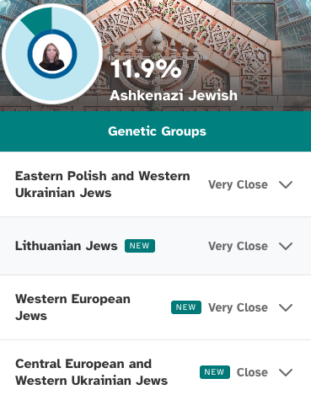
    On my paternal side, my Ashkenazi Jewish ancestry does not come from my Y-DNA line but from a different paternal branch. We know that my 2x great-grandfather, Abraham Israel, came from Poland, and our family has strong ancestral ties to Ukraine. These results fit well with what we know so far.
    MyHeritage

    MyHeritage has once again accurately identified my European origins, while also providing a more detailed breakdown of my Ashkenazi ancestry.

    MyHeritage claims to offer the most diverse and detailed Jewish ethnicity analysis available, with five Jewish ethnic groups and 55 Genetic Groups of Jewish origin.
    European Breakdown

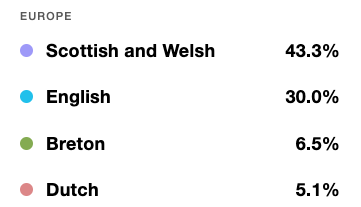
    My results show:

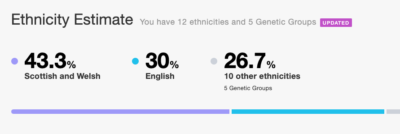
    • 43.3% Scottish & Welsh

    • 30.0% English

    This seems reasonable, especially if the Welsh category includes some of my West Midlands ancestry. However, I find it odd that Scottish and Welsh are grouped together.

    The biggest surprise in this update is the unexpected appearance of:

    • 6.5% Breton

    • 5.1% Dutch

    These results seem questionable, and I suspect they may disappear in future updates.

    Ashkenazi Jewish Breakdown

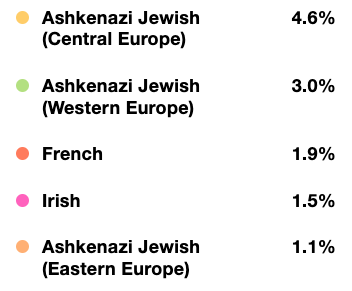
    Unlike other testing companies, MyHeritage provides a more nuanced interpretation of my Jewish ancestry, dividing it into:

    • 4.6% Ashkenazi Jewish (Central Europe)

    • 3.0% Ashkenazi Jewish (Western Europe)

    • 1.1% Ashkenazi Jewish (Eastern Europe)

    This level of detail helps clarify regional origins within my Ashkenazi lineage, which aligns with what I know about my family’s history.
     

    Family Tree DNA

    My FamilyTreeDNA myOrigins® Version 3 Results

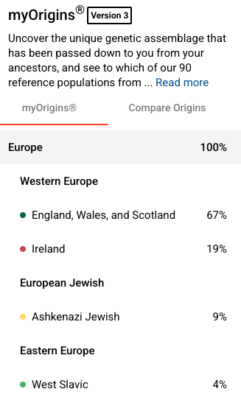
    Here’s a look at my latest myOrigins® Version 3 results from FamilyTreeDNA. As expected, my ancestry is 100% European, but the breakdown offers some different results from the other testing companies.
    Western European Ancestry

    • England, Wales, and Scotland – 67%

    • Ireland – 19%

    This aligns well with my known family history. The grouping of England, Wales, and Scotland together makes it harder to pinpoint specifics, but given my strong West Midlands roots, I assume much of this percentage is from that region. The 19% Irish is also intriguing—it could be linked to either my Scottish or West Welsh ancestors, though more research is needed to confirm.

    European Jewish Ancestry

    • Ashkenazi Jewish – 9%

    This fits closely with what I already know about my Ashkenazi Jewish heritage, which comes from my great-grandfather’s line. It’s interesting to see this as a single category here, whereas other testing companies sometimes divide Ashkenazi ancestry into more specific regions.

    Eastern European Ancestry

    • West Slavic – 4%

    This is an interesting addition. My Ashkenazi Jewish ancestors had strong Polish and Ukrainian ties, so it makes sense that a Slavic percentage appears in my results. It would be interesting to see if this changes in future updates.

    Overall, these results are a good match for my documented genealogy, though the broad regional groupings leave some room for interpretation. It will be interesting to compare this with future updates and results from other DNA testing companies!

    LivingDNA

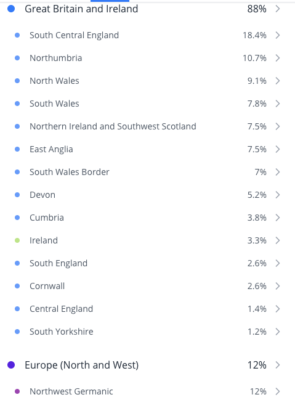
    My Living DNA results provide a detailed breakdown of my British and Irish heritage, with 88% of my ancestry linked to regions across Great Britain and Ireland. Unlike some other testing companies, Living DNA offers a more regionalized view, identifying specific areas where my ancestors may have lived.
    British Isles Breakdown

    The largest proportion of my ancestry is from South Central England (18.4%), which aligns with my known family history. There are also notable contributions from Northumbria (10.7%), North Wales (9.1%), and South Wales (7.8%), suggesting a mix of English and Welsh ancestry. The Northumbrian doesn’t fit with documented research nor the results from other companies, but the Welsh is more accurate.

    Other regions appearing in smaller percentages include:

    • Devon (5.2%) and Cornwall (2.6%), possibly indicating connections to the West Country.

    • Cumbria (3.8%), which may be linked to the English-Scottish border region.

    • South Yorkshire (1.2%), a relatively small proportion but still notable.

    No Jewish ancestry has been identified in this breakdown, despite its appearance in results from other companies. It is unclear where it is.

    Germanic Ancestry

    Unlike previous tests, Living DNA has identified a 12% Northwest Germanic component. Could this be connected to the missing Ashkenazi ancestry? Or could it reflect historical migration into Britain, possibly from Anglo-Saxon or Viking populations>

    Conclusions

    Overall, my updated BGA results offer a detailed view of my British ancestry, highlighting multiple regional connections and providing valuable insights into broader ancestral patterns. However, there is still room for improvement, and I look forward to future updates.
     

  2. Book Review and Author Interview: Secret Missions Of The Suffragettes: Glassbreakers & Safe Houses by Jennifer Godfrey

    September 2, 2024

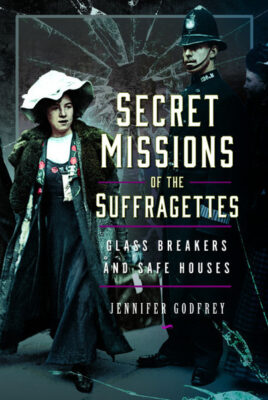
    Secret Missions of the Suffragettes: Glassbreakers and Safe Houses by Jennifer Godfrey (P&S History, 2024)

    In her latest social history book, Secret Missions of the Suffragettes: Glassbreakers and Safe Houses, Jennifer Godfrey explores the suffragette movement’s clandestine activities during the early 20th century. The narrative focuses on the Women’s Social and Political Union’s (WSPU) window-smashing protest in March 1912, led by Emmeline and Christabel Pankhurst. This protest involved over 250 women who used hammers and stones to smash windows in London as a demonstration against the government’s refusal to include women in their reform bill.

    Secret Missions of the Suffragettes details the intricate planning and execution of these missions, highlighting the use of safe houses, rest homes, and the suffragettes’ strategies for evading police surveillance. The narrative also covers the suffragettes’ self-defence training, the use of disguises, and communication through codes and aliases. Throughout Godfrey paints a vivid picture of the suffragettes’ determination and the lengths they went to in their fight for women’s suffrage, while also giving a broad overview of the behind-the-scenes efforts that were crucial to their cause.

    This book sheds light on a lesser-known aspect of suffragette history and is essential reading for anyone interested in suffragettes, political movements, or women’s social history.

    Interview with Jennifer Godfrey

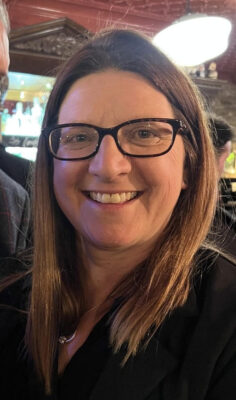
    What was your background before writing this book?
    I trained as a buyer and then qualified as a solicitor gaining invaluable research & writing skills that I have transferred to all my subsequent roles including writing books. Most recently I worked for a local district council in their community team working with the voluntary sector and designing, securing funding and delivering projects. This is my second book about the women’s suffrage movement in the UK. My first book, also published by Pen & Sword is called Suffragettes of Kent (published 2017).

    Your book explores the “Secret Missions of the Suffragettes.” With so many books, films and documentaries already covering the suffragettes and their cause, how challenging was it to uncover aspects that had stayed hidden or weren’t as well known?
    I haven’t found it challenging as I believe there are many untold stories waiting to be discovered and alternative story angles to use. When writing my first book about suffragettes in Kent I came across a young (19-year-old) working-class maid and suffragette called Ethel Violet Baldock. A local newspaper had dedicated a couple of lines to her story of arrest in London. I took this and began searching for more information and as a result was able to contact her granddaughters, great niece and great great niece as well as uncover some limited information in archives. Ethel and her previously untold story have been my inspiration for my books. She was arrested at the 1912 Great Militant Protest as a glass breaker (the mission featured in my second book) and imprisoned in Holloway along with the likes of Emmeline Pankhurst.

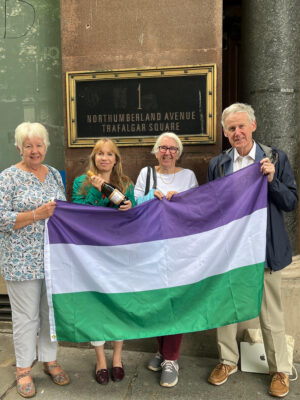
    It is not just stories of previously unknown suffragettes that are waiting to be told – the opportunity to tell stories about known suffragettes with a different angle or focus is also out there! An example is the approach I chose for conveying the 1912 glass-breaking mission. I wanted to understand how those involved were partnered (i.e. the process including instructions etc.), who they were with and where they went. This opened up a whole new set of questions (i.e. did they know each other before? How experienced at mission activity were they? Who was working behind the scenes pairing suffragettes and giving them stones and hammers? etc.) to attempt to answer which in turn added layers to the known stories whilst identifying some previously untold ones. The Annex in the Secret Missions of the Suffragettes details all those known to have been involved in the 1912 glass breaking and groups them according to when and where they were breaking glass. Interestingly this focus has led to a fantastic opportunity for me to unite the descendants of two partnered glass breakers, Ethel Violet Baldock and Violet Bland. We went to number 1 Northumberland Avenue where Ethel and Violet (known as Annie) had smashed a window 112 years ago.

    Left to Right: Patricia Radley (Ethel’s granddaughter); Sandra Radley (Ethel’s great-granddaughter); Eileen Bridges (Ethel’s granddaughter); Eamonn Butler (Violet Bland’s great nephew)
    Who was the most memorable glass breaker you encountered in your research?
    That’s very difficult to answer. If pushed I would say apart from the inspiration for the book, Ethel Violet Baldock, it would be either Janet Barrowman or Lillian Ball. Glaswegian Clerk, Janet Barrowman was 32 and chief clerk at Scottish soap manufacturer, Joseph Watson & Co., known as ’Soapy Joes’. According to the letter sent in by her manager, David Wilkie, Janet had asked for two days’ holiday to see a demonstration in London. Janet had been arrested and charged for smashing a window at the Local Government Board. Like the other glass breakers she had been given a longer than expected sentence. Janet received a sentence of two months and despite David’s attempt to have this reconsidered and reduced she served the full term. As a result, having exceeded her maximum holiday allowance, she lost her job, one which she was extremely accomplished and respected. It is memorable because of her 11 years service to Soapy Joes at a high level (she was often left in charge of the business in Scotland) and the sacrifice she made in taking part in this mission. Her wage was supporting her widowed mother and younger siblings so it was a huge blow. Also memorable was Lillian Ball, a working-class dressmaker from Tooting in London. She gave evidence against Emmeline Pankhurst in the case of conspiracy to incite others and was even cross-examined by the leader in court! After the court hearing, she had to be moved to Reading prison for her own safety.

    What’s next for you? 
    I am currently writing my third book, also about women’s suffrage and again inspired by the youngest 1912 glass breaker Ethel Violet Baldock.

    Jennifer Godfrey lives in West Kent with her husband, two children and dog. She is the author of two non-fiction books, published by Pen & Sword Ltd, the first, Suffragettes Of Kent and the recently released Secret Missions Of The Suffragettes: Glassbreakers & Safe Houses.

  3. Book Review and Author Interview: Angel Meadow by Dean Kirby

    November 21, 2023

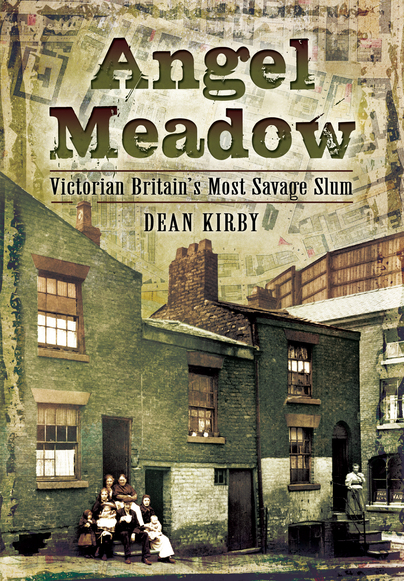
    Angel Meadow

    Angel Meadow: Victorian Britain’s Most Savage Slum by Dean Kirby (P&S History, 2016)

    Dean Kirby’s immersive exploration of Manchester’s Angel Meadow slum in the Victorian era is a compelling journey into one of the most notorious and dangerous neighbourhoods of the Industrial Revolution. In his meticulously researched book, Kirby, drawing on his journalistic background, vividly resurrects the scenes and characters that define this grim chapter in history.

    The book is thoughtfully structured around real events, offering readers a glimpse into the shocking and colourful stories that unfolded in Angel Meadow. Kirby’s dedication to historical accuracy is evident, as he taps into a diverse range of sources, including newspaper accounts, police reports, teachers, missionaries, and magistrates. This thorough approach results in a comprehensive historical record that becomes an essential resource for anyone interested in the lives of those who inhabited this bleak corner of the northern metropolis.

    What sets Kirby’s work apart is not only its historical depth but also its connection. This project is a labour of love for the author, inspired by the experiences of his ancestor, William Kirby, a farm labourer who fled Ireland’s Great Hunger only to face the grim reality of the industrial north.

    The narrative is enriched with a glossary of Angel Meadow slang, providing a linguistic window into the past, and supplemented by a bibliography, research notes, and a detailed index. These elements contribute to the book’s value as both an engaging read and a scholarly reference.

    In summary, Dean Kirby’s book on Angel Meadow is a masterful blend of historical documentation and personal passion. It not only brings to life a vivid and dangerous Victorian slum but also honours the author’s familial connection to the tumultuous events that unfolded in this dark corner of Manchester’s past.

    Interview with Dean Kirby

    What was your background before writing this book?  

    I was born and grew up in Manchester and am very proud of the city and fascinated by its history. Manchester was the first industrial city and played a significant role in the creation of the modern world. My dad has always told me stories about Ancoats, the inner city district where he lived as a young lad, and we would spend hours in Manchester Central Library in the 1980s researching our family history – before genealogy was fashionable – using the old, dimly-lit microfilm readers that genealogists used before records were digitised and which were probably really bad for your eyes. After university, I became a journalist and I’ve spent most of my career working in Manchester – going out into communities and talking to ordinary Mancunians about what was happening in their lives – which has given me an even greater appreciation for my home city and its people. The book happened really because these two things – my family history and my passion for the city and its history – came together quite dramatically in 2016.  

    Your ancestor William Kirby lived in Angel Meadow. Was it solely the discovery of his residence there that inspired you to write about Victorian Britain’s most challenging slum, or were there other motivating factors?

    I had been researching my Irish ancestor William Kirby, my 3 x great-grandfather, on and off since those early days in the library with my dad. William was a farm labourer from County Mayo who arrived in Manchester in the 1860s. Like a lot of poor Irish immigrants at that time, he lived with his family underground in a cellar. Using maps, rate books and other records, I eventually managed to locate the site of his house in a car park in Angel Meadow, where I used to park my car because it was convenient for the Arndale Centre. In Manchester, when slum clearances took place after the Second World War, the houses were simply backfilled into cellar holes and sealed over with concrete. As the city centre is largely flat, a lot of that land was turned into surface car parks which are only just now being redeveloped. 
    One night in 2016, I was walking past the car park where Williams’ house had been with my wife as we went to a Noel Gallagher gig at Manchester Arena and noticed that, amazingly, there was a fence up and a big sign saying “archaeologists at work”. The next day I went back and told them my story. They invited me inside to look at their finds and later let me bring along my dad to climb down a ladder into the cellar holes and touch the bricks of William’s fireplace. They let me take the brick home and I’ve kept it. It still has soot on it from the fire that would have kept him warm on a winter’s day. A death certificate showed that one of William’s children, also called William, died in that house from a fever aged just two weeks old. It says something about the horrible living conditions there, but it also affected the archaeologists, they said, because that’s how long their dig lasted – the same number of days as baby William’s short life. 

    Visiting the house was a hugely poignant moment for me. As family historians, we all spend our time searching for pieces of paper that will give us a glimpse of how our ancestors lived, but in that moment, we were able to walk right through the front door. That moment inspired me to write the book about the district where William lived and to go on to do a doctorate in urban history – researching the Victorian housing conditions in the same area of Manchester. It means I’ve been researching that small area of the city for a decade now. I’m still very grateful to the archaeologists who didn’t turn me away when I turned up with what must have seemed a surprising story. Instead, they invited me in and encouraged me, and I’m hoping that my PhD study of Angel Meadow’s housing will give something back to them and help them in their own research going forward.   
     

    Did you have concerns about portraying some of the distressing stories you encountered during your research?

    I did have concerns about portraying some of the distressing stories in the book and there were some that I left out because they were just too unbearable to write about. It was also quite harrowing at times being immersed in those stories during what was four years of research and writing. One story that played on my mind quite a bit was about a woman named Annie Chapman, who was found dead in a privy in Angel Meadow. It’s only a few paragraphs in the book, but her story was so tragic that I thought about her quite a lot while I was writing. One valid criticism of the book was that I didn’t write about the families who lived good, honest lives and never found themselves in trouble with the police or the pages of a newspaper. I totally agree and there’s also an obvious gap in telling the stories of women who lived in working-class districts in the nineteenth century because their stories are often missing from the historical record, or written by men such as police officers and church missionaries who knew nothing really about women’s lives. All I could do, as I was writing about an era which no one is alive to remember, was to use as many different sources as I could find and try my best to portray people’s lives as accurately and fairly as I could. I also felt it was important to treat the people whose stories I was telling with respect and be a voice for them if I was able, as, like my own family who lived in the district, these were real people and the ancestors of modern-day Mancunians. In a way, the book was my attempt to keep alive the stories of those people and to explain what they went through while living in very difficult circumstances.

    Who was the most memorable individual you encountered in your research for the book?

    There were a few memorable people I encountered in my research and some had interesting nicknames such as Cabbage Ann, the Badger, One-Armed Kitty and Jemmie the Crawler. One thing I enjoyed doing was using genealogy techniques to try to work out the real identities of the people behind the nicknames and find out a bit more about their lives. The Badger, for example, was a thief named John Currie and it was said that he could climb down coal chutes to break into houses. By looking at his prison record though, I also found that his distinguishing marks included his neck being bloated and badly scarred by scrofula, an infection of the lymph nodes caused by tuberculosis. It’s a horrible nickname to have given to someone with a medical condition, but in the days before mugshots and fingerprinting the name would have been a way for police officers to identify him in the street. Cabbage Ann’s real name was Ann Powell and she ran a grocer’s shop and a lodging house. She was a notorious thief trainer who taught youths how to be “breech buzzers” or pickpockets. The most memorable person in my research though was a violent character named Henry Burgess, who would go around Angel Meadow attacking passers-by and the police with anything he could lay his hands on. He had 40 convictions to his name including killing an opponent by throwing a paraffin lamp at him and setting him on fire. I was very lucky to find a photograph of Henry in the Staffordshire Gaol image archive, which is a useful resource for historians searching for Victorian criminals who were transported from the North of England to jails in the South such as Dartmoor, Pentonville and Parkhurst. They would stop at Stafford Gaol on the way and have their photograph taken. It was fascinating to see Henry’s piercing eyes peering back at me in the photograph and to notice that on his neck he had a huge scar, which may have been a knife wound that would have put his life in danger before he was stitched up by a surgeon. 

    One of my greatest joys in writing the book is that I have been contacted by lots of people who have found their ancestors in the index and have been in touch to find out more information. I was really lucky to chat with one of Henry Burgess’s descendants recently who wanted help with their genealogy research and I was able to pass on some documents and the photograph. They had been unaware of his past until reading about him in the book and it was a real privilege to chat to them after spending so much time thinking and writing about Henry during my own research. 

    What’s next? Can we expect more books?

    Since writing the book, I have been taking an even deeper dive into Angel Meadow by researching my PhD, which I finished last year. I really enjoyed it but I’m keen now to write another Manchester history book. I am currently doing some research. Beyond that, I’ve started a newsletter telling stories from the streets of Victorian Manchester, which is free to join. I’m also in the process of setting up a genealogy business so I can help more people find their Mancunian ancestors and tell their stories.    

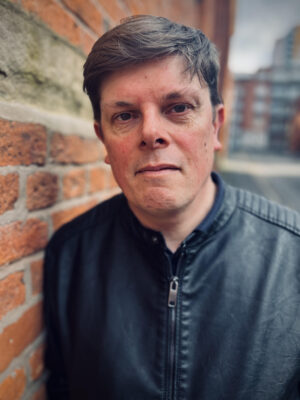
    Dean Kirby is an award-winning investigative journalist whose nominations include being shortlisted for the Orwell Prize for Exposing Britain’s Social Evils for his work on the UK’s fuel poverty crisis. His book on Angel Meadow has been in the Amazon best-seller lists. He now writes a weekly newsletter telling stories from the streets of Victorian Manchester, which can be found at www.manchesterhistory.uk.

  4. Book Review and Author Interview: Rural: The Lives of the Working Class Countryside by Rebecca Smith

    March 21, 2023

    Rural: The Lives of the Working Class Countryside by Rebecca Smith (HarperCollins, 2023)

    The publisher’s blurb describes this as “a book for anyone who loves and longs for the countryside, whose family owes something to a bygone trade, or who is interested in the future of rural Britain.” Many of us love the countryside but with 82.9% of England’s population, 83% of Scotland and around 80% of Wales (2019) living in urban areas, Britons may seem more detached than ever from rural life. Those of us with UK ancestors are likely to have at least some forebears living in the countryside in the first half of the 19th century, if not later. And with debates about fuel and food dominating recent headlines, awareness of our rural economies, communities and environment urgently needs to improve.

    I was particularly keen to read this book as I grew up in rural Lancashire in the 1980s and ’90s. It was a world that even then felt remote and misunderstood. On my first day of secondary school, for example, I was astonished at how many of my new classmates had never heard of the village where I lived. Sadly, I was equally ignorant of city ways, constantly getting lost trying to find the bus station after school for my long and winding journey home. As the daughter of the forester on the Graythwaite Estate in Cumbria, Rebecca Smith was raised in an even more remote area around 40 miles from me. 

    Smith’s family had long ties to the land: her ancestry includes foresters in Cumbria, miners in Derbyshire, millworkers in Nottinghamshire, and builders of reservoirs and the Manchester Ship Canal. In Rural, she explores the realities of life in the country, weaving back and forth between her childhood, life now in rural Scotland, her ancestors’ experiences, and those of other lives on estates and farms across the UK.

    I’m often frustrated by contemporary media accounts which simplify or glamorise rural life, focusing on Downton Abbey-style worlds, wild swimming, or cooking on the AGA. In fairness, there have been some improvements on television recently, but Smith’s book provides a healthy counterbalance to the twee, shining a light on professions and communities that many know nothing about. She has a healthy curiosity for the variety of rural lives and a rich range of sources – as evinced by the detailed reference section at the end of the book.

    I was pleased to read of a world I recognised, both the past of my ancestors and the precarious world of my farming friends who are forever multi-tasking and coming up with creative ways to turn a profit in a challenging economy. Whether you are interested in diving deeper into the everyday lives of your ancestors or are keen to understand more about the rural economy and the importance of caring for the countryside in all our lives, this book is warmly recommended.

    Interview with Rebecca Smith

    What was your background before writing this book?

    I worked in radio for over a decade. After graduating with an English and Media degree from Stirling University, I wanted to write but had no idea how to do it. I had really enjoyed the radio aspect of my degree so managed to get some work experience in local BBC Radio and basically never left. I worked on live programmes, news phone-ins, comedy, features, drama. I was always really keen to tell other people’s stories. To give people a voice who didn’t usually have one. I found different lives fascinating.
    Latterly, I worked in Radio 4’s Scotland’s office and really loved working with books and scripts again. At that point, I decided it was time to start writing myself. After I had my second kid, I decided to go freelance and take a Masters in Creative Writing at Glasgow Uni. Then I came up with the book!
    Why did you want to write Rural?
    I read a lot and love so many genres but I never really came across anything which I thought, yes, that’s me. There were a lot of working-class stories coming out when I started writing but nothing about rural areas. So I started writing about that. Also, I think quite subconsciously, I always wrote about the place I grew up as if it had some kind of tether to me. We lived on a country estate in Cumbria, which immediately makes people think we were posh, but we were anything but. We were given a tied house, which meant the house came with the job. If you lost one, you lost the other. There was a whole community of people living like this who ran the Big House and the land; the farmer, the plumber, the housekeeper, the gamekeeper, and the forester (my dad.) I wanted to tell this story, about belonging to a place when you don’t own any of it. It was only when I started talking to my family I realised that they had all lived in tied houses in rural areas their whole lives, generations of them. No wonder I felt tethered to this kind of place; it was in my blood.

    Why did you feel that exploring the lives of the working-class countryside was important?

    Originally I was only going to write about country estates and those microcosms of societies. But the more I thought about it, and ultimately spoke to family, the more I realised so many more rural industries had tied housing. Coal mining, slate mining, millwork. My grandad was born in a dam builders hut just above Sheffield. My Great Grandmother had thirteen children and had numerous lodgers come and go to help with the money coming in. I had no idea about this until I spoke to my Uncle Jim. I was very lucky he is a keen family researcher. He sent me lots of information which was just fascinating. I wish I had spoken to my Grandad about it all before he died. Not only was he born on the moors as a dam builder’s son, he went on to be a coal miner during the war, and then worked in a mill.
    There is a lot of literature about these industries but I wanted to write about all of them in the same place, because I found the people who work in them are all connected in so many ways. But I also wanted to write about them from a woman’s point of view. I was pregnant while writing some of the book which has the ability to totally change your perspective! When I thought about my Great-Grandmother with her thirteen children, plus lodgers, in a tiny hut miles away from anywhere, it makes you wonder how they did it.

    What’s next for you and your writing?

    I have an idea for the next one but it’ll take me quite some time to formulate anything worthwhile just yet! The lead up to this first book (plus my there children) will keep me busy enough for now I think.
    Rebecca Smith is a writer from Cumbria. She worked in radio for ten years before completing a Masters in Creative Writing at Glasgow University. She lives in Central Scotland with her partner and three children. Rural: The Lives of the Working-Class Countryside is her first book.
    Contact Rebecca via her website or follow her on Twitter.


  5. Book Review and Author Interview: After The War by Tom Palmer

    February 14, 2023

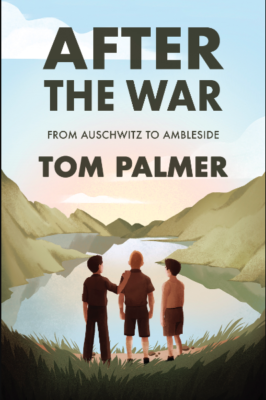
    After The War: From Auschwitz To Ambleside by Tom Palmer (Barrington Stoke, 2020)

    Anyone who watched BBC TV’s drama, The Windermere Children, or its accompanying documentary cannot fail to have been moved by the true story of the young survivors of the Holocaust, the care they received in the Lake District, and their eventual (and remarkable) joy, enthusiasm and life-long friendships.

    Experienced children’s author, Tom Palmer, was so inspired by the children’s stories that he approached Trevor Avery BEM of the Lake District Holocaust Project to ask if he could write a book about the Jewish children and their time by Windermere. In Trevor’s foreword to the book, he praises Tom for being “utterly dedicated to doing the story justice” and for “being always full of the same compassion as those who helped the children in their early days of recovery”.

    Although the story is fiction, it is based on the recollections of some of the survivors, as well as those of Holocaust experts. Tom spoke personally with Arek Hersh, Mala Tribich, and Ike Alterman, three of the Windermere children. He also met with Joyce, whose family were bombed out of Liverpool, moving to the Calgarth Estate by Windermere during the war. Joyce and her dog, along with football coach, Jock Lawrence, are a few of the real people who appear in Tom’s novel. However, Tom makes clear in his acknowledgements that every scene in the book is “based on the recollection of real events”.

    After the War centres on three boys out of the three hundred children who arrived in the Lake District at the end of the Second World War in August 1945. The story focuses on Yossi, his friendship with Leo and Mordecai, his memories (told in flashbacks) of his life before and during his time in Nazi concentration camps, and his hopes for a reunion with his missing father.

    Tom manages to clearly convey the horrors and realities of the Holocaust in a way that is suitable for young readers. The story is engaging, easy to read and well-paced, using flashbacks in a way that avoids any scene from becoming overwhelming. Overall, the book captures the humanity of the Windermere children, the local people who became their friends, and the special adults who helped them heal and prepare them for an adult life filled with peace and hope.

    What was your background before writing this book?

    I had written lots of sport fiction and some history stories, most based very closely on the testimony of those involved. Before that, I was a bookseller (Waterstone’s and Dillons) and worked for libraries and The Reading Agency.

    Why did you want to write about the “Windermere children”?

    I didn’t at first. I didn’t feel like I could do it. But my wife and then a Holocaust historian I came to know encouraged me and gave me the belief. Then I was swept up by the story of how these children came to the UK as refugees having lost everything and everyone and – through friendship with each other – found some hope.

    Why did you feel this was an important story to tell?

    So that we don’t forget the Holocaust. So that we see such events coming next time and do something about it. So that we can see how refugees can benefit from coming to a safe country and how that safe country can benefit from having refugees come.

    What’s next for you and your writing?

    Another one set in Cumbria. It’s going to feature water and mountains and a couple of aeroplanes. That’s all I can say at the moment.

    Tom Palmer is a children’s author. He writes historical and sports fiction and has been nominated for the Carnegie medal four times. Winner of the UK Children’s Book Award in 2020 and the Ruth Rendell Award for services to literacy in the UK, he has been translated into 13 languages. www.tompalmer.co.uk


  6. « Earlier articles

    Later articles »

Search Blog


Categories

  • Black Country
  • Book Reviews
  • Book Writing
  • Camden
  • Chelsea
  • Children
  • Crime
  • DNA
  • Family History
  • Genealogy
  • Genetic Genealogy
  • History
  • Immigration
  • India
  • Italy
  • Jane Carlyle
  • London
  • London history
  • Memoir
  • Mid century history
  • Photo Restoration
  • Social History
  • Technology
  • Thomas Carlyle
  • USA
  • West Midlands
  • Women's History
  • Worcestershire

Recent Comments

    • Baby Name Namesakes: Harriet Beecher Stowe in the UK – Baby Name Blog - Nameberry on NAMING NAPOLEON: how exploring first names can give an insight into Victorian world history.
    • Baby Name Namesakes: Harriet Beecher Stowe in the UK – Baby Name Blog - Nameberry on Naming for Empire
    • Emma Jolly on Writers’ Blog Tour
    • Deepa on Writers’ Blog Tour
    • Emma Jolly on Historic Newspapers

Blog Archive

September 2026
M T W T F S S
 123456
78910111213
14151617181920
21222324252627
282930  
« May    

Tags

  • 1911 census bolton wanderers british library camden council camden local studies census charles dickens christmas christmas carol crimea eliza fay em forster emma jolly exhibition family history family history for kids genealogy grandparents history india interview relatives joe smith john richardson lma london london metropolitan archives Manchester museum of london names nhs nhs bill nun nurses pancras record their stories social history st pancras theatre history victorian history war

Latest From Emma's Blog

A History of the Census Takers: Recording the Nations by Mish J Holman (Pen & Sword, 2026)

Looking beyond the census returns to explore the lives and personalities of the people who created them A History of […]

[Read more]

Book Review and Author Interview: A History of Parish Registers in England and Wales: From the Restoration to Civil Registration by John Wintrip (The Lutterworth Press, 2026)

A History of Parish Registers in England and Wales: From the Restoration to Civil Registration by John Wintrip (The Lutterworth Press, […]

[Read more]

From Twitter

Tweets by emmajolly
Member of The Society of Authors Member of The Association of Genealogists and Researchers in Archives Graduate of the Institute of Heraldic and Genealogical Studies Canterbury Member of the Society of Genealogists Pharos Tutors
Follow Emma on Twitter Follow Emma on Instagram Connect with Emma on LinkedIn Connect with Emma on Medium
Copyright © 2026 Emma Jolly     Terms and Conditions / Privacy Policy
website by beachshore